What full-spectrum grow-light labels actually tell you
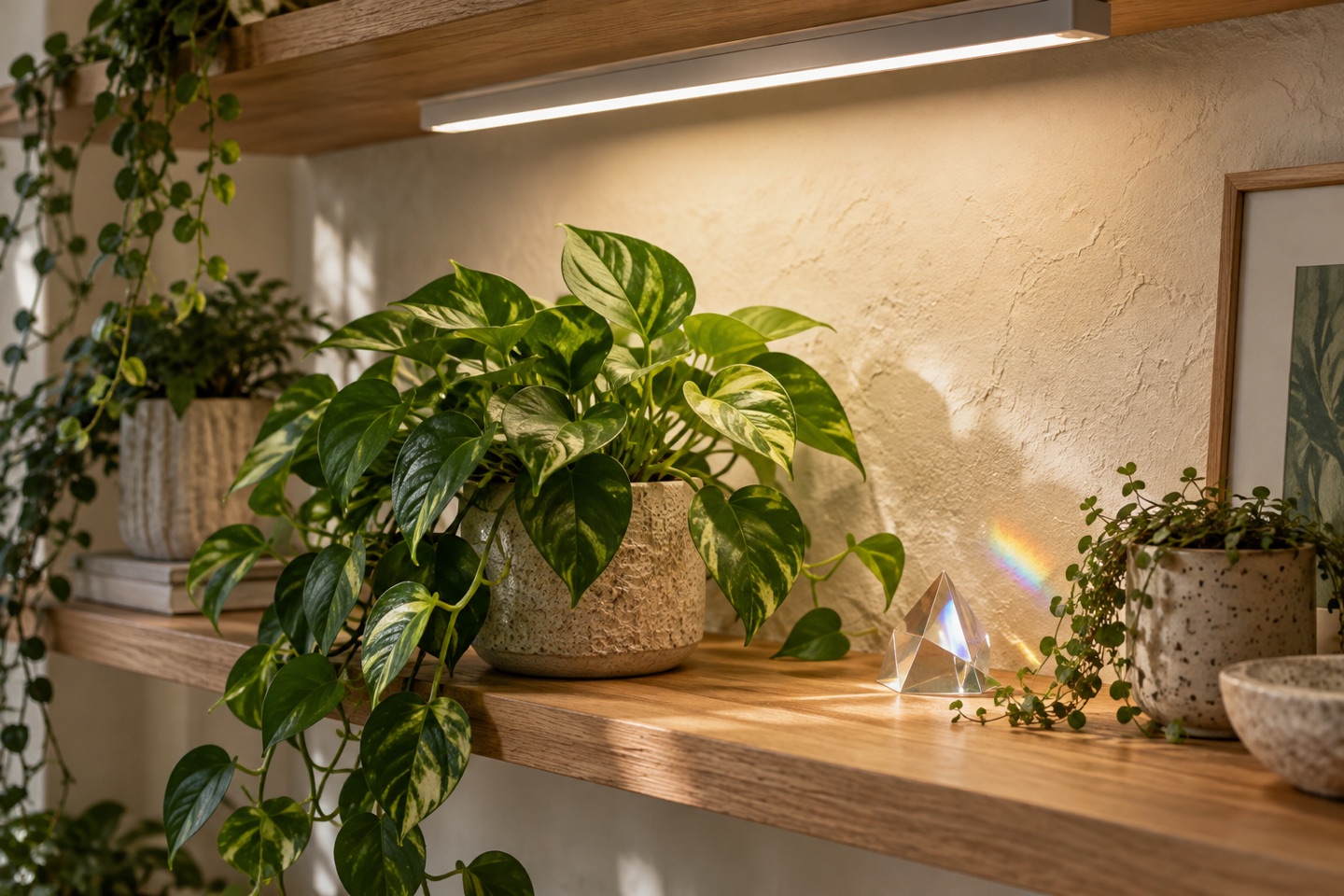
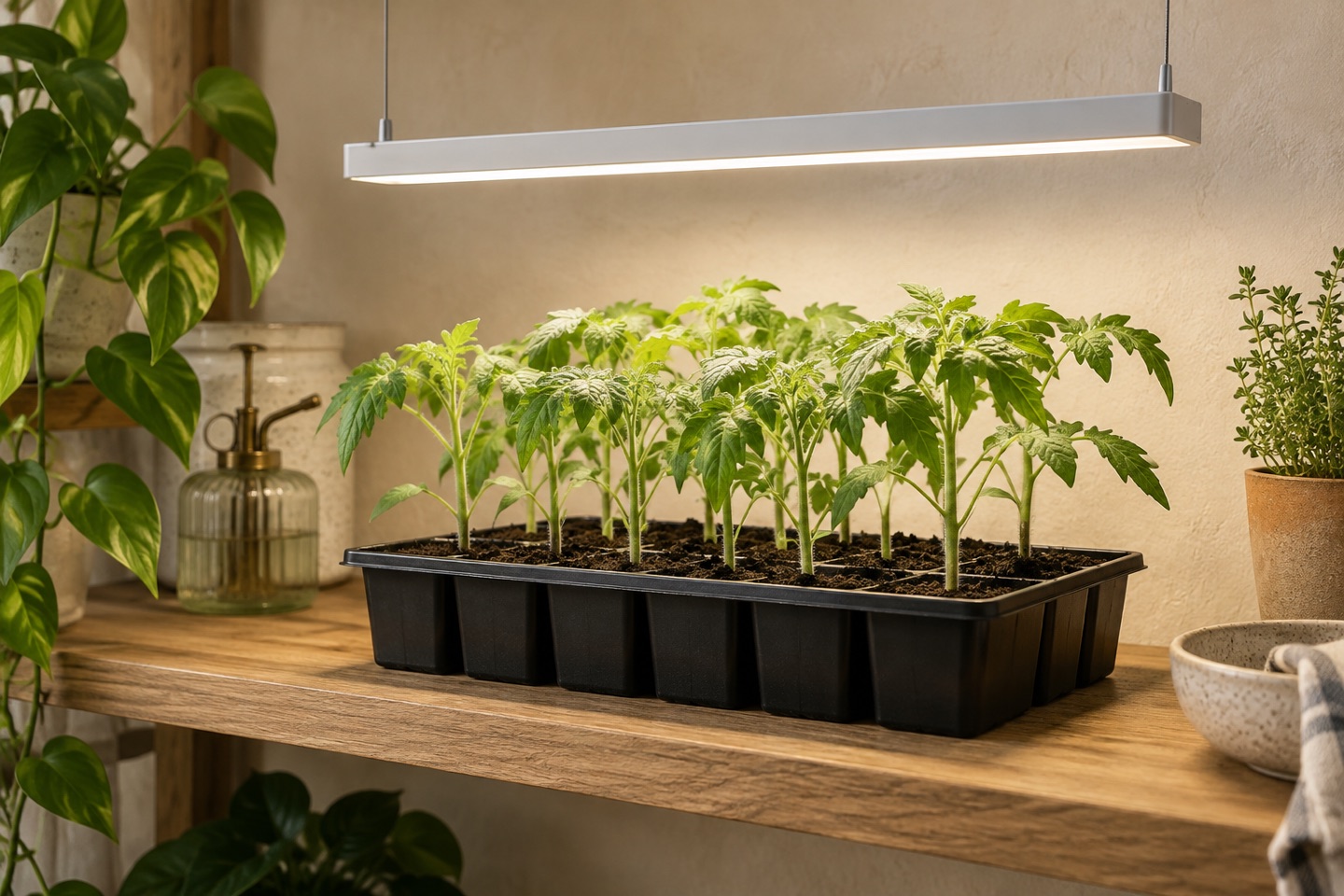
Two grow lights can both say full spectrum while creating very different arrangements above your plants. One is a bulb pointed at a small display; another is a long fixture spread across trays. The shared label does not tell you which one fits your room or how much light reaches the outer leaves.
We recommend using spectrum information as one part of a complete comparison. Check the growing footprint, output at a practical mounting distance, controls, and actual input power alongside the label. This guide explains which numbers answer useful buying questions and how to compare fixtures without turning a marketing phrase into a product ranking.
As an Amazon Associate I earn from qualifying purchases. Amazon links below are paid links. Read our disclosure.
This guide combines source-based research with practical arrangement advice. We have not conducted hands-on product tests.
Four quantities answer four questions
Begin by writing the job in plain language: one desk plant, a row of pots, or two trays on a rack. That sentence narrows the forms you need to compare. A bulb and a bar may share a spectrum label, but their positioning options are different. Choose an appropriate shape before getting lost in increasingly detailed graphs.
Then look for a spectrum description for the exact model. A color temperature tells you something about visual appearance, while a spectral diagram offers more detail about the emitted wavelengths. Neither replaces a coverage measurement. For a light that will stay visible in the room, appearance matters alongside plant lighting. You should be comfortable leaving the installation operating on the schedule you intend to use.
Electrical watts describe input power. PPF describes photon output from the fixture in micromoles per second. PPFD describes photon flux arriving per unit area, in micromoles per square metre per second. DLI describes the accumulated photon quantity over a day. Iowa State Extension explains these measurement terms.
A label can state one of these without supplying the others. A good spectrum chart still does not establish edge-to-edge coverage over your shelf.
Ask for a usable map
Keep each measurement with the question it answers. Actual watts help estimate electricity use. PPF describes overall photon output. PPFD describes photons arriving over an area and becomes useful when the distance, lamp setting, and measured positions are known. A big figure without those conditions can be difficult to apply to your display.
For example, compare a center reading with readings at the edges of the growing footprint, not with an unrelated bulb's total output. If two product pages use different units, pause rather than forcing them into a ranking. A complete comparison may require better documentation from the seller. The most useful specification is the one you can connect to the arrangement you plan to install.
Look for a PPFD map naming the exact fixture, mounting height, tested footprint and dimmer setting. Check its edges, not only the highest centre value. Keep those details together when comparing products. A reading at twelve inches is not interchangeable with one at twenty-four inches.
If the manufacturer provides only a broad spectrum label and equivalent wattage, you have insufficient information for a numerical light-fit decision. You can still compare dimensions and mounting choices, but label the output unknown.
Compare like with like
Decide which details are necessary for your purchase and which are interesting background. A casual shopper does not need to become a lighting engineer to choose between a desk lamp and shelf bars. You do need enough information to understand the fixture's fit, limits, and expected routine.
Make a short comparison sheet for the two most promising options. Include form, mounting requirements, current model identity, coverage evidence, timer or dimmer behavior, and total purchase cost. Mark missing information explicitly. This prevents a colorful spectrum graph from distracting you from a basic problem such as a fixture that is too long for the shelf or cannot be adjusted within the available headroom.
Keep current model revisions separate from older versions. Check whether a listed wattage is per bar or per pack. For a bulb, confirm whether the documentation refers to the same bulb shape and base sold in the listing.
Use our tools for arithmetic and geometric fit. They deliberately do not infer plant-light intensity from electrical watts. No single label replaces the combination of suitable plant guidance and documented fixture conditions.
Choose a fixture that suits this job
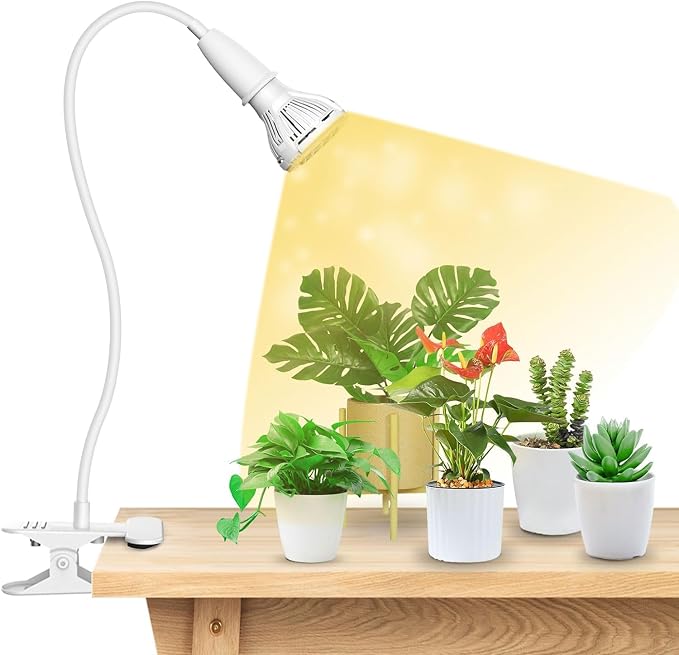
SANSI 10W adjustable clip-on
For one compact plant display, we recommend the SANSI one-head 10W clip-on as an adjustable option when the furniture provides a suitable mounting edge. The clamp leaves the surface available for the pot, while the arm lets you position the head independently of that attachment point. That is particularly useful beside a desk or a small plant stand where another lamp base would be inconvenient.
The bulb can be replaced separately, giving you a component to change rather than necessarily replacing the whole fixture. Check compatible replacements and the fixture rating before ordering a different bulb. Plan the arrangement around the plant's foliage and leave the required clearance: SANSI's precautions specify at least one foot and warn against touching the operating bulb. For a wide display, choose a wider lighting arrangement rather than expecting this small head to reach every plant. We have not established its exact growing footprint through independent measurements.
View SANSI 10W adjustable clip-on on Amazon (paid link)
SANSI BR30 36W grow bulb
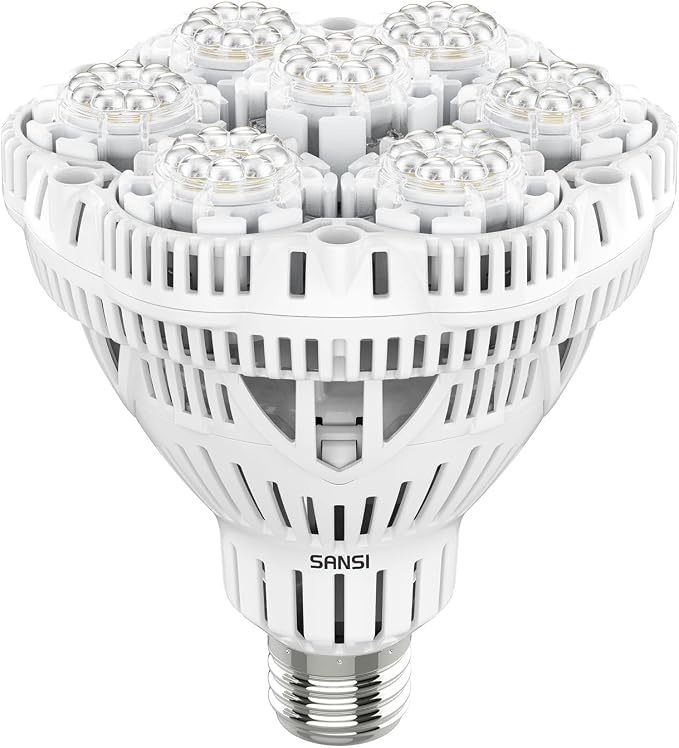
The SANSI BR30 36W bulb is our screw-in option to compare when you want to choose your own suitable fixture. Its appeal is flexibility: a separately purchased lamp can give you the reach, base position, and visual style that work in your room. The US version uses an E26 base, but matching that base is only the first compatibility check.
Compare bulb dimensions, fixture rating, approved orientation, ventilation, and the manufacturer's instructions before combining them. Do not place this 36W bulb in SANSI's 10W clip-on assembly. An open, compatible fixture may suit your plans better than trying to hide a large bulb inside an unsuitable shade. We recommend this route to buyers willing to check the complete combination; a ready-made plant lamp is simpler when you want fewer compatibility decisions. Use the exact BR30 documentation when evaluating output, because an older review of a similarly named SANSI bulb may describe another design.
View SANSI BR30 36W grow bulb on Amazon (paid link)
Barrina T5 shelf-bar family
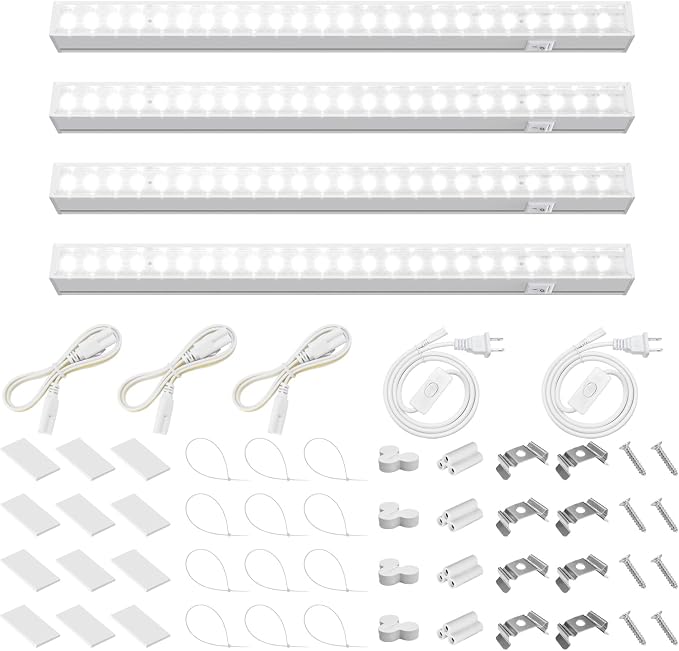
For a compact shelf, the Barrina T5 one-foot, white-cover four-pack is our modular option to compare. Separate bars let you plan their positions around a row of pots or a small tray, rather than placing one spotlight over the middle. The selected listing includes connecting cords and several mounting components, and describes a 20W total across the four bars. Use the exact pack when checking what you need.
This version is non-magnetic; other Barrina listings have different covers and attachment systems. Choose mounting hardware suited to your shelf and follow the surface restrictions in the instructions. For instance, tape has a different job on a smooth panel than on a wire rack. We favor these bars when flexibility in arranging a small shelf matters. The tradeoff is more individual pieces and cables to organize. Do not assume that four bars automatically cover a particular tray: check the intended mounting distance, distribution, and plant requirements before deciding how many to install.
View Barrina T5 shelf-bar family on Amazon (paid link)
Make the setup easy to use
Evaluate a complete arrangement
A good comparison includes the lamp, its mount, the space it occupies, and the routine you will use. Put your proposed fixture into a simple sketch showing the foliage, shelf edges, cord route, and access for watering. Include room to make adjustments. A fixture that technically fits can still be inconvenient when its switch is behind the plants or its cable crosses the area where you lift containers.
Compare two options using the same growing footprint and available mounting height. Keep the model, revision, and controls with any published measurements. If one map was made closer to the light or inside reflective walls, it is not a direct comparison with a map made farther away on an open shelf. Ask for missing conditions before treating a large headline number as useful evidence.
Separate light quantity from power use
PPFD describes light arriving at a surface, while watts describe electrical input. Both are useful, but they answer different questions. Record readings where the leaves sit and look at several positions across the display. A lamp can have a high center reading without distributing that light in the shape you need. Published PPF is overall output; it does not establish a particular leaf-level reading.
For a constant reading, DLI equals PPFD multiplied by daily hours and 0.0036. An illustrative 100 µmol/m²/s for twelve hours therefore gives 4.32 mol/m²/day. This is arithmetic, not a plant recommendation. Changing daylight requires measurements over time, so one noon window reading should not be multiplied by the entire day. Keep biological guidance separate from the calculation.
Include the ongoing expense
A hypothetical 30W light running twelve hours daily for thirty days uses 10.8 kWh. At an assumed $0.15 per kWh, that is $1.62 for the month. Use actual input power and your own tariff, then add mounts, compatible bulbs, and any timer to the upfront comparison. A cheaper lamp that needs additional fixtures may become a more expensive complete setup. Decide what meets the task before deciding which price looks best.
Compare three products without a false ranking
For a compact furniture display, the SANSI clip-on illustrates the value of an adjustable head and a small installation. For a separately chosen fixture, the SANSI BR30 bulb illustrates the flexibility and additional compatibility checks of the bulb route. For a shelf, Barrina bars illustrate modular positioning across a row. These are different jobs, so we would not select one winner merely from the words full spectrum.
Imagine a shopper who already has a suitable lamp, another who needs to keep a desk surface free, and a third who has several pots beneath a shelf. The bulb, clip, and bars each offer a different practical starting point. The useful comparison is what each complete arrangement requires and whether its documentation supports the growing area.
If a product claims a result for every growth stage, read that as a seller claim until there is appropriate evidence. Ask how the claimed output was measured and which plants or conditions were involved. You can still make a positive recommendation about a verified design advantage while keeping unsupported crop outcomes out of the decision.
Our recommendation
Use full-spectrum wording to begin the comparison, then choose by the complete task. We recommend comparing fixture shape, practical mounting distance, documented distribution, and control behavior before price. Actual power belongs in the running-cost calculation, not in a shortcut ranking of plant performance.
Before buying, make sure the model and measurements match, and identify any missing fact that would change your choice. If the only available evidence is a broad marketing label, choose a better-documented option. A clear specification sheet and a workable installation are more useful than the most impressive adjective on the box.
When you are ready to compare listings, consider SANSI 10W adjustable clip-on (paid link) for an adjustable compact display; SANSI BR30 36W grow bulb (paid link) for a compatible lamp you choose separately; Barrina T5 1FT white-cover four-pack (paid link) for a modular compact shelf. Check the selected version and included components before ordering.
Research sources and scope
Plant guidance comes from the references below. Fixture links accompany the relevant recommendations. Arrangement examples and purchasing advice are our analysis. We report no hands-on product trials or independently measured growing footprints.
- Iowa State Extension: considerations for supplemental indoor lighting ↗Reviewed 2026-09-27
- Independent review: SANSI multi-head clip-on; model differs ↗Reviewed 2026-09-27
- Independent SANSI brand review; exact BR30 performance not established ↗Reviewed 2026-09-27
- Independent Barrina review; longer version, not an exact one-foot test ↗Reviewed 2026-09-27