Calathea grow-light placement without guessed targets
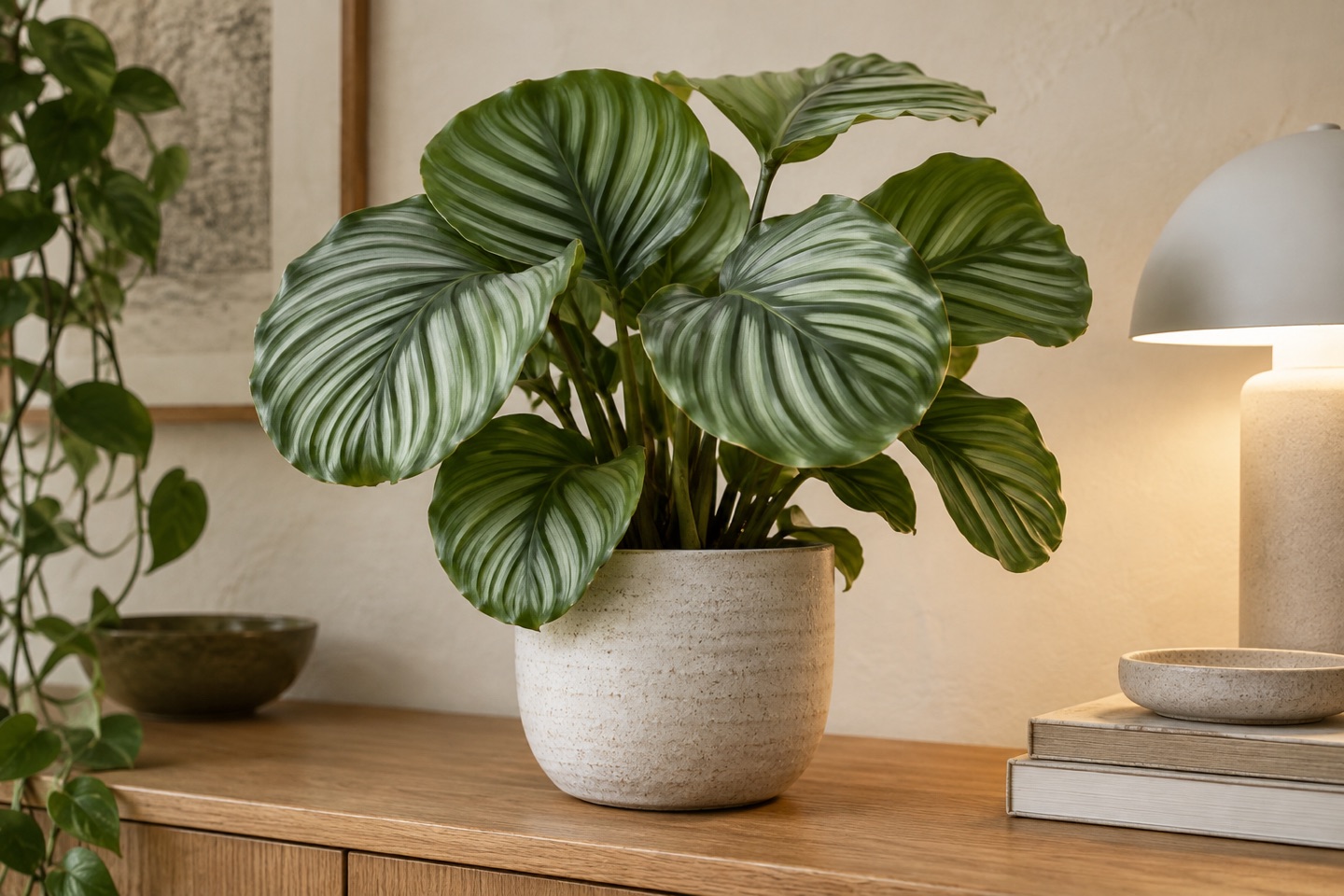
A Calathea display is often about enjoying patterned leaves in a favorite part of the room. If that location needs supplemental light, the sensible purchase is an arrangement you can control and maintain, not simply the brightest lamp on a marketplace page. The plant, the lamp, and the room should remain comfortable together.
We recommend starting with species guidance and a practical position, then comparing a focused adjustable lamp with bars for a small shelf. Many plants still sold as Calathea are now classified as Goeppertia. This guide helps you match the care reference, choose a fixture form, and avoid making precise lighting claims from appearance alone.
As an Amazon Associate I earn from qualifying purchases. Amazon links below are paid links. Read our disclosure.
This guide combines source-based research with practical arrangement advice. We have not conducted hands-on product tests.
Check the name on the label
Record the plant's label and check whether the reference uses Calathea or Goeppertia. A name change can make useful care information harder to find, and a broad shopping search may group quite different plants together. Keep the identity with any lighting recommendation you decide to follow.
Decide what is missing from the current arrangement. A plant behind a curtain or beneath a deep shelf may receive different daylight from one beside a window. Note that difference before choosing a lamp. If a more suitable position is available and works for your display, moving the pot may be the easiest improvement. If the plant needs to stay where it is, plan a modest, adjustable installation with a clear purpose.
Many houseplants sold as Calathea are classified in Goeppertia. NC State’s genus reference describes indirect, medium-to-lower light and warns that direct sun can scorch foliage. A genus reference is context, not a measured optimum for every cultivar.
Keep the nursery label so you can look up the actual plant. If you cannot verify its identity, use qualitative guidance rather than assigning a precise light target.
Choose a controllable arrangement
Think about the full leaf spread and normal leaf positions when drawing the setup. The lamp should leave room above and around the foliage, with its minimum clearances preserved. Avoid placing the head tightly against the current outline simply because it makes a tidy photograph.
For a tabletop plant, check whether the clamp can reach a useful position without crossing your watering route. For a small shelf collection, check the height of each plant before setting one fixture above all of them. Group similar arrangements where possible so you can make changes deliberately. Leave the controls accessible. A useful installation lets you adjust and inspect the plants without moving the whole collection every time.
Sketch the leaf height and width, the window and the proposed lamp position. A lamp that can be moved offers a way to make a modest placement change. Keep its support and clearances within the exact fixture instructions.
If a shelf bar’s map is available, compare the tested distance with your shelf. Do not claim that its highest PPFD is appropriate just because it looks impressive.
Read symptoms cautiously
Keep the rest of the care record beside the lighting notes. The plant reference discusses humidity, watering, drafts, and other conditions that can affect the leaves. Curling or a brown edge is therefore not an instruction to increase light automatically. Look at the whole situation before buying another fixture.
After a lighting change, record the date, position, and schedule rather than making several further adjustments at once. Use a consistent photograph as a reference and note new growth separately from existing damage. Follow plant-specific guidance when deciding what to change. If you are measuring output, record the instrument and leaf position so the number has context. A reading can help describe the arrangement; it does not diagnose every leaf problem.
NC State’s reference lists several possible causes of leaf problems. Curling or browning therefore should not be treated as a calibrated light meter. Note moisture, drafts and room conditions before changing the fixture.
Make one recorded adjustment and recheck the arrangement. Our calculator can describe entered PPFD and hours, but it does not diagnose leaves or establish a cultivar-specific target that the evidence does not supply.
Choose a fixture that suits this job
SANSI 10W adjustable clip-on
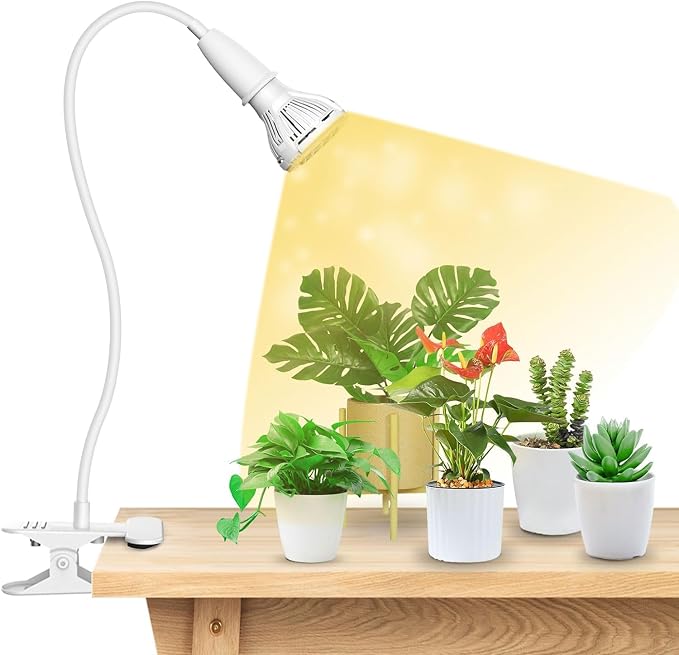
For one compact plant display, we recommend the SANSI one-head 10W clip-on as an adjustable option when the furniture provides a suitable mounting edge. The clamp leaves the surface available for the pot, while the arm lets you position the head independently of that attachment point. That is particularly useful beside a desk or a small plant stand where another lamp base would be inconvenient.
The bulb can be replaced separately, giving you a component to change rather than necessarily replacing the whole fixture. Check compatible replacements and the fixture rating before ordering a different bulb. Plan the arrangement around the plant's foliage and leave the required clearance: SANSI's precautions specify at least one foot and warn against touching the operating bulb. For a wide display, choose a wider lighting arrangement rather than expecting this small head to reach every plant. We have not established its exact growing footprint through independent measurements.
View SANSI 10W adjustable clip-on on Amazon (paid link)
Barrina T5 shelf-bar family
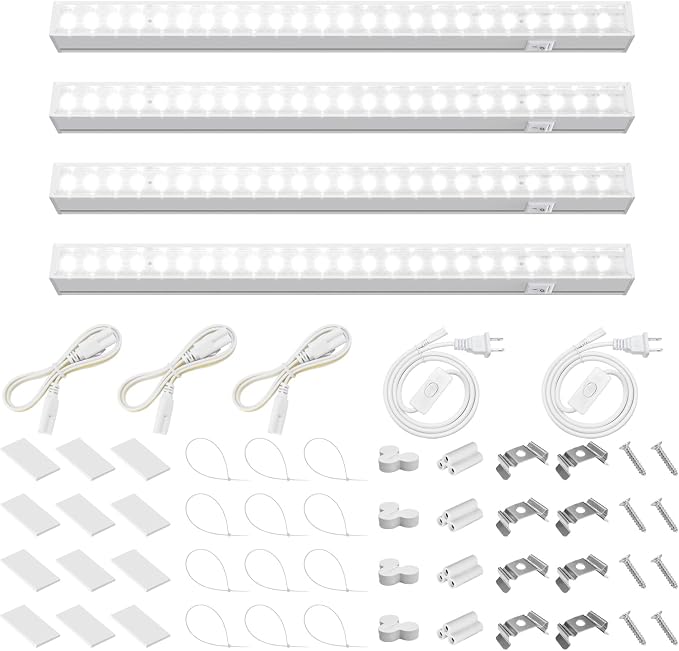
For a compact shelf, the Barrina T5 one-foot, white-cover four-pack is our modular option to compare. Separate bars let you plan their positions around a row of pots or a small tray, rather than placing one spotlight over the middle. The selected listing includes connecting cords and several mounting components, and describes a 20W total across the four bars. Use the exact pack when checking what you need.
This version is non-magnetic; other Barrina listings have different covers and attachment systems. Choose mounting hardware suited to your shelf and follow the surface restrictions in the instructions. For instance, tape has a different job on a smooth panel than on a wire rack. We favor these bars when flexibility in arranging a small shelf matters. The tradeoff is more individual pieces and cables to organize. Do not assume that four bars automatically cover a particular tray: check the intended mounting distance, distribution, and plant requirements before deciding how many to install.
View Barrina T5 shelf-bar family on Amazon (paid link)
Make the setup easy to use
Make the timer fit the room
A routine that runs without daily reminders is one of the best practical improvements you can make. Decide when you want the display illuminated and when you want the room dark, then check that the schedule fits the plant's care guidance. The lamp should help you enjoy the room rather than become something you repeatedly switch off because it interferes with reading, work, or sleep.
Confirm how the exact fixture behaves after the timer removes and restores power. An electronic control that needs another button press can frustrate an otherwise sensible plan. Keep the switch accessible after routing the cord. If reaching it means moving three pots, change the arrangement before you settle into regular use.
Track the arrangement, not just the switch
Record the light position, daily schedule, and date of installation. Take a reference photograph in consistent ordinary lighting, then use later pictures and new growth to evaluate your care routine. A photograph is a record, not a calibrated measurement, and a change in the plant does not prove that the lamp caused it. Keep watering, temperature, and other care observations alongside the lighting notes.
If you measure output, record the reading at foliage height and the lamp setting. Check the outer leaves as well as the center. PPFD describes light arriving at an area; a manufacturer's PPF figure describes overall output and cannot replace those placement details. A reading made with a phone also needs the appropriate settings or calibration for its light source. Preserve that context so a later adjustment is a comparison you can understand.
Estimate the complete running cost
Use actual input watts for every lamp you will operate. As an illustration, a 20W arrangement running twelve hours daily for thirty days uses 7.2 kWh. At an assumed $0.15 per kWh, that is $1.08. Replace both numbers with your planned power draw and local tariff. This estimate excludes purchase cost and other equipment; it is not a quoted bill or a recommended schedule. Our light-and-cost calculator makes that arithmetic easier when you are comparing two complete setups.
Choose the arrangement you can adjust calmly
For one plant on a side table, the SANSI clip-on is a positioning option to compare when its reach and clearance suit the display. The appeal is a dedicated head and movable attachment point. Check the view from nearby seating before settling on the location.
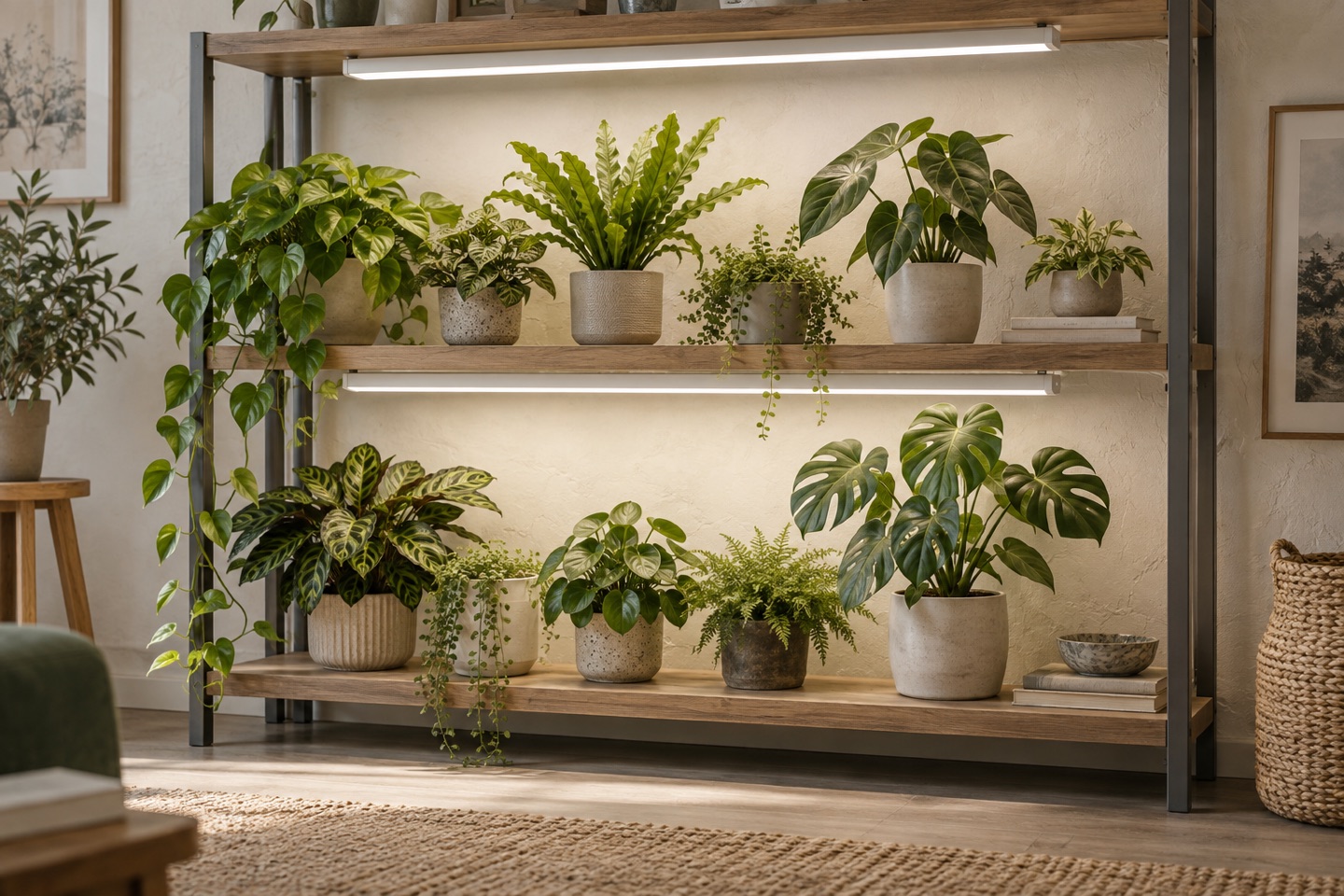
For several plants along a shelf, Barrina bars provide a modular layout to investigate. Keep the plants accessible and evaluate the actual foliage footprint rather than counting pots. A single shelf can contain different heights, so decide whether the plants should be grouped differently before fixing the bars.
For a plant in a humid display area, start with the equipment's environment restrictions. Do not assume that an indoor light can be used in a misted or enclosed arrangement because it appears in somebody else's photograph. If the proposed environment does not meet the instructions, choose a different setup. The light should be part of a sustainable care routine, with each component used in the conditions for which it is intended.
Our recommendation
Use a light to improve a defined Calathea or Goeppertia display, guided by the plant's identity and existing conditions. We recommend comparing a focused adjustable arrangement for one plant and bars for a compact shelf, with clearances and output checked for the exact model.
Before buying, confirm the care reference, map the leaf spread, plan accessible controls, and check the approved environment. Keep watering and humidity in the evaluation. A measured, repeatable adjustment is more useful than repeatedly changing equipment in response to every imperfect leaf.
When you are ready to compare listings, consider SANSI 10W adjustable clip-on (paid link) for an adjustable compact display; Barrina T5 1FT white-cover four-pack (paid link) for a modular compact shelf. Check the selected version and included components before ordering.
Research sources and scope
Plant guidance comes from the references below. Fixture links accompany the relevant recommendations. Arrangement examples and purchasing advice are our analysis. We report no hands-on product trials or independently measured growing footprints.
- Goeppertia — NC State Extension ↗Reviewed 2026-09-27
- Iowa State Extension: supplemental indoor light and measurement concepts ↗Reviewed 2026-09-27
- Independent review: SANSI multi-head clip-on; model differs ↗Reviewed 2026-09-27
- Independent Barrina review; longer version, not an exact one-foot test ↗Reviewed 2026-09-27