Clip-on grow lights: reach, clamp fit and light footprint
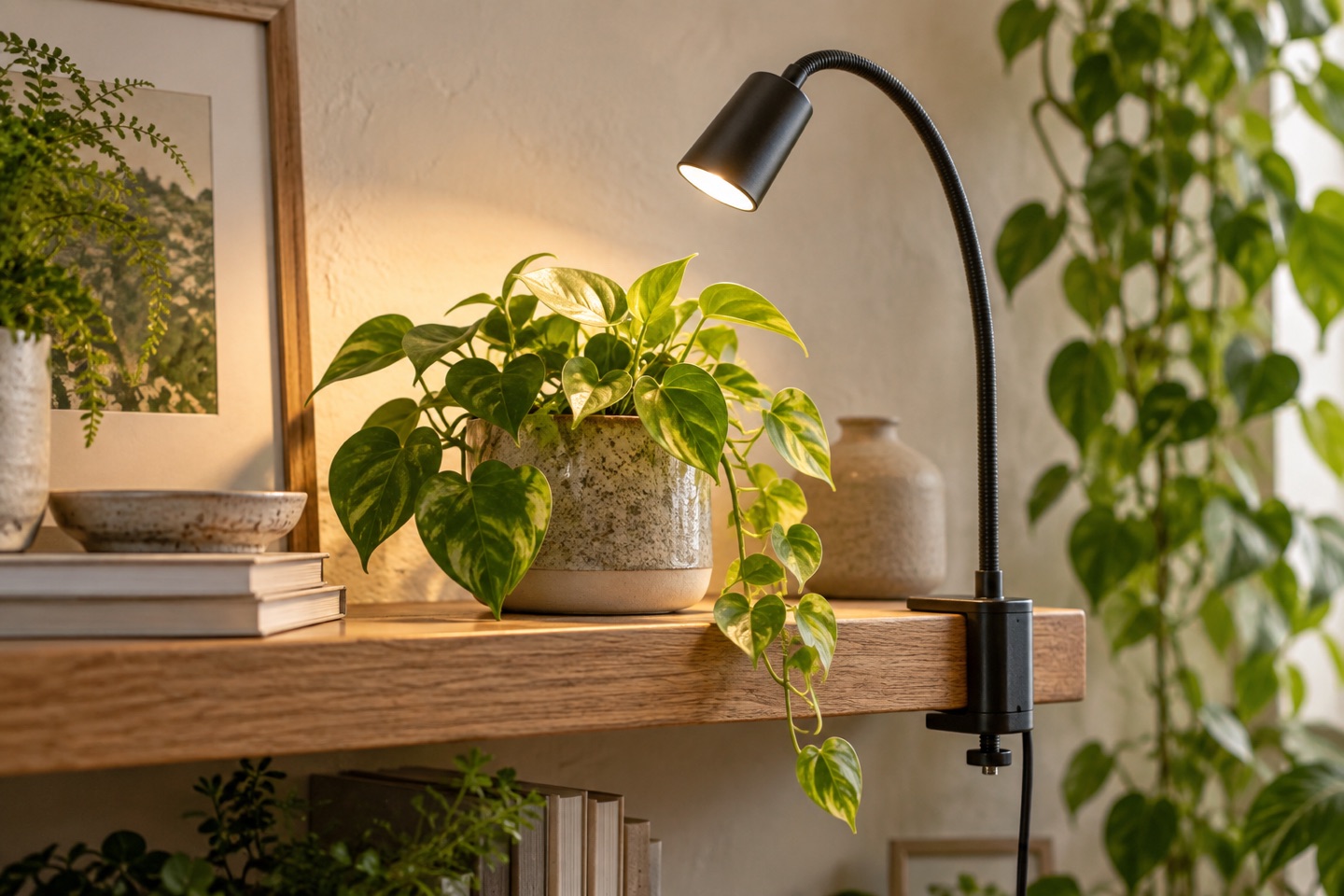
A clip-on grow light is appealing because it can add a dedicated light without occupying the surface where the plant sits. Clip it to a suitable edge, position the arm, and the pot keeps its place. That simple idea works best when you choose the lamp around the furniture and foliage rather than around the product photograph.
We recommend checking three things before buying: the mounting surface, the arm's usable reach, and the growing area beneath the head. The SANSI one-head lamp is our verified clip-on example. A separate bulb and compatible lamp are worth comparing when the proposed display needs a different reach or fixture form.
As an Amazon Associate I earn from qualifying purchases. Amazon links below are paid links. Read our disclosure.
This guide combines source-based research with practical arrangement advice. We have not conducted hands-on product tests.
Measure the surface
Measure the thickness of the edge and look at both sides of the surface where the jaws will sit. A lip, bevel, narrow trim, or obstructed underside can change whether the clamp has a suitable attachment point. Check the manufacturer's opening range and restrictions instead of assuming that every shelf edge behaves the same way.
Think about normal use of that furniture. The clamp should not interfere with a drawer, curtain, door, or the route used to lift the pot. The main benefit is freeing up tabletop space; placing the clamp where it complicates the rest of the room loses that advantage. If no appropriate edge exists, choose a fixture with another suitable support rather than modifying the furniture around an uncertain attachment.
Measure the thickness and shape of the proposed shelf or desk edge. Compare it with the exact clamp’s published opening and approved use. A rounded rail, thin shelf lip and flat desk edge are not equivalent gripping surfaces.
Do not claim that a clamp is secure merely because its opening is large enough. Surface finish, geometry and the extended arm matter; actual grip strength is not established by our specification comparison.
Check the arm in the real layout
Draw a side view with the clamp position, the head, and the tallest foliage. The arm needs to reach the useful lamp position while preserving the fixture's required clearance. Its full straightened length is not necessarily the reach available in the shape you will use.
Leave the cord enough freedom for normal adjustments, but route it so movement does not pull on the attachment. Keep the switch accessible after the plant is in place. A flexible arm is helpful for a small display because you can change the head position independently of the pot. It becomes less useful when you must stretch it into an awkward position just to reach the center of the growing area.
Draw the clamp position and the foliage you want to reach. Compare usable reach and adjustment with that drawing. An arm length can include portions that do not translate into horizontal reach above the leaves.
Keep the lamp within the manufacturer’s supported orientation and load. If the bulb is replaceable, confirm the fixture’s stated power limit and compatible bulb specifications rather than installing a stronger bulb by default.
Separate reach from light output
Decide whether the lamp is serving one compact plant or a wider collection. A movable head can be easy to position above the first task; the second may call for bars or another broader arrangement. Physical reach and adequate distribution are separate questions.
Compare the exact lamp's instructions and available output documentation at the intended distance. If you move the head to one side to make the room more comfortable, consider how that changes the growing area rather than assuming the same result. More heads can offer positioning choices, but they also add controls, cords, and parts to arrange. Choose the least complicated setup that meets a clearly described job, with uncertain coverage recorded honestly.
After confirming placement, compare documented PPFD at the intended distance. A bright centre reading from an unrelated model does not show coverage for this clamp lamp.
Check timer instructions and how controls behave after power interruption. Manufacturer documentation can support dimensions and stated limits; it cannot substitute for our own grip, durability or growth testing, which we have not performed.
Choose a fixture that suits this job
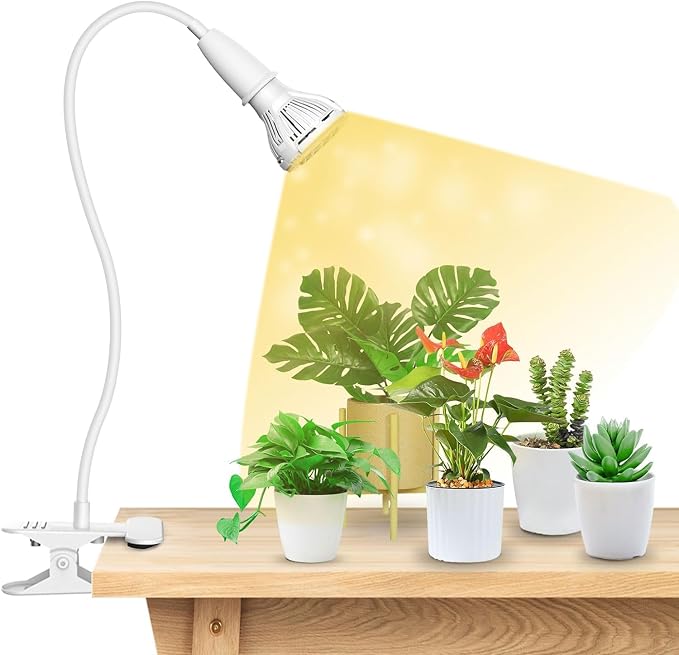
SANSI 10W adjustable clip-on
For one compact plant display, we recommend the SANSI one-head 10W clip-on as an adjustable option when the furniture provides a suitable mounting edge. The clamp leaves the surface available for the pot, while the arm lets you position the head independently of that attachment point. That is particularly useful beside a desk or a small plant stand where another lamp base would be inconvenient.
The bulb can be replaced separately, giving you a component to change rather than necessarily replacing the whole fixture. Check compatible replacements and the fixture rating before ordering a different bulb. Plan the arrangement around the plant's foliage and leave the required clearance: SANSI's precautions specify at least one foot and warn against touching the operating bulb. For a wide display, choose a wider lighting arrangement rather than expecting this small head to reach every plant. We have not established its exact growing footprint through independent measurements.
View SANSI 10W adjustable clip-on on Amazon (paid link)
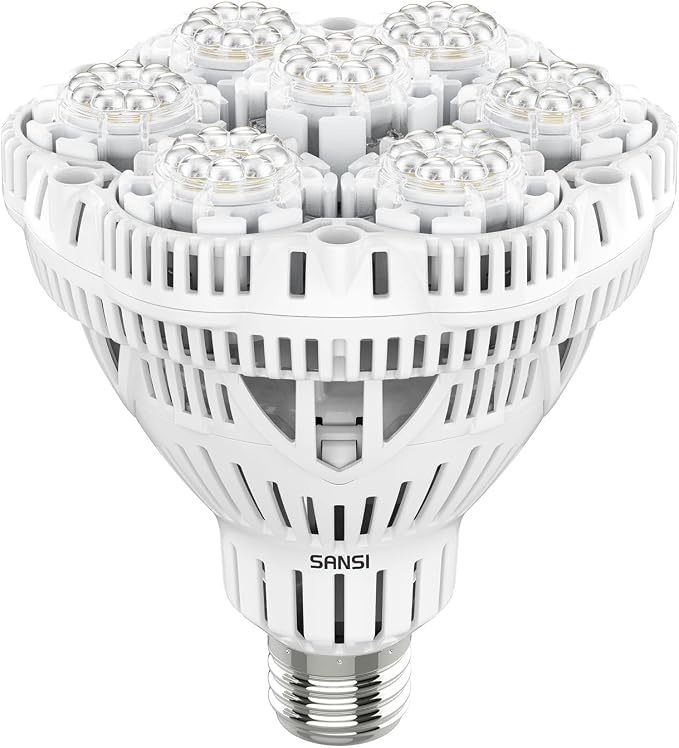
SANSI BR30 36W grow bulb
The SANSI BR30 36W bulb is our screw-in option to compare when you want to choose your own suitable fixture. Its appeal is flexibility: a separately purchased lamp can give you the reach, base position, and visual style that work in your room. The US version uses an E26 base, but matching that base is only the first compatibility check.
Compare bulb dimensions, fixture rating, approved orientation, ventilation, and the manufacturer's instructions before combining them. Do not place this 36W bulb in SANSI's 10W clip-on assembly. An open, compatible fixture may suit your plans better than trying to hide a large bulb inside an unsuitable shade. We recommend this route to buyers willing to check the complete combination; a ready-made plant lamp is simpler when you want fewer compatibility decisions. Use the exact BR30 documentation when evaluating output, because an older review of a similarly named SANSI bulb may describe another design.
View SANSI BR30 36W grow bulb on Amazon (paid link)
Make the setup easy to use
Evaluate a complete arrangement
A good comparison includes the lamp, its mount, the space it occupies, and the routine you will use. Put your proposed fixture into a simple sketch showing the foliage, shelf edges, cord route, and access for watering. Include room to make adjustments. A fixture that technically fits can still be inconvenient when its switch is behind the plants or its cable crosses the area where you lift containers.
Compare two options using the same growing footprint and available mounting height. Keep the model, revision, and controls with any published measurements. If one map was made closer to the light or inside reflective walls, it is not a direct comparison with a map made farther away on an open shelf. Ask for missing conditions before treating a large headline number as useful evidence.
Separate light quantity from power use
PPFD describes light arriving at a surface, while watts describe electrical input. Both are useful, but they answer different questions. Record readings where the leaves sit and look at several positions across the display. A lamp can have a high center reading without distributing that light in the shape you need. Published PPF is overall output; it does not establish a particular leaf-level reading.
For a constant reading, DLI equals PPFD multiplied by daily hours and 0.0036. An illustrative 100 µmol/m²/s for twelve hours therefore gives 4.32 mol/m²/day. This is arithmetic, not a plant recommendation. Changing daylight requires measurements over time, so one noon window reading should not be multiplied by the entire day. Keep biological guidance separate from the calculation.
Include the ongoing expense
A hypothetical 30W light running twelve hours daily for thirty days uses 10.8 kWh. At an assumed $0.15 per kWh, that is $1.62 for the month. Use actual input power and your own tariff, then add mounts, compatible bulbs, and any timer to the upfront comparison. A cheaper lamp that needs additional fixtures may become a more expensive complete setup. Decide what meets the task before deciding which price looks best.
When a clamp helps—and when another form is easier
For one small plant on a suitable shelf edge, the SANSI one-head 10W lamp offers a focused, adjustable arrangement. Its replaceable bulb is a useful ownership feature, although replacements must match the fixture's requirements. Check the approved clearance before deciding that a small-looking head will fit under a low shelf.
For a taller plant beyond the clamp's reach, a separate compatible fixture may be more convenient. The SANSI BR30 36W bulb illustrates that route, but it is a different bulb and must not go into the 10W clip-on assembly. Choose a lamp rated and sized for that exact bulb. Include the fixture cost when comparing it with the ready-made clip-on.
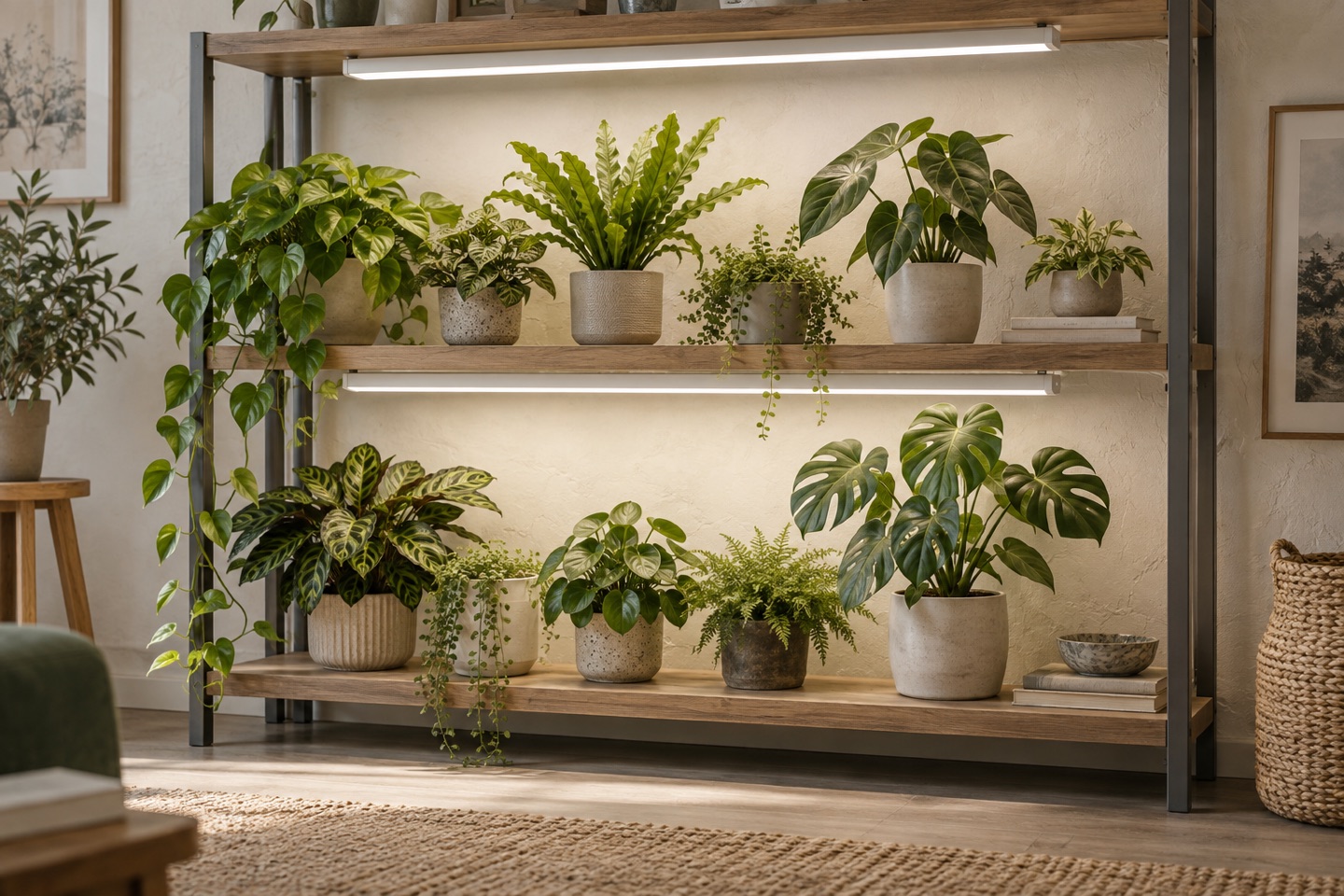
For a row of pots, compare a shelf-oriented arrangement instead of buying several clamps automatically. Draw the foliage footprint and wiring route first. Multiple adjustable heads can suit genuinely separate plants, while one organized shelf arrangement may be easier for a shared growing area. The useful purchase follows the layout. If you cannot describe where each head will sit and what it will serve, settle those decisions before adding more fixtures to the cart.
Our recommendation
A clip-on grow light is a sensible form for a compact display when the mounting edge, reach, and required clearance all work together. We recommend the one-head approach for a defined small job, with its coverage evaluated separately from the arm's position.
Choose a different support or a shelf fixture when the clamp cannot reach comfortably or the foliage occupies a wider area. Before buying, measure the real edge, sketch the head position, and plan accessible controls. That short exercise helps preserve the convenience that makes a clip-on attractive in the first place.
When you are ready to compare listings, consider SANSI 10W adjustable clip-on (paid link) for an adjustable compact display; SANSI BR30 36W grow bulb (paid link) for a compatible lamp you choose separately. Check the selected version and included components before ordering.
Research sources and scope
Plant guidance comes from the references below. Fixture links accompany the relevant recommendations. Arrangement examples and purchasing advice are our analysis. We report no hands-on product trials or independently measured growing footprints.
- Supplemental-light considerations — Iowa State Extension ↗Reviewed 2026-09-27
- Independent review: SANSI multi-head clip-on; model differs ↗Reviewed 2026-09-27
- Independent SANSI brand review; exact BR30 performance not established ↗Reviewed 2026-09-27