How to choose a grow-light stand that fits
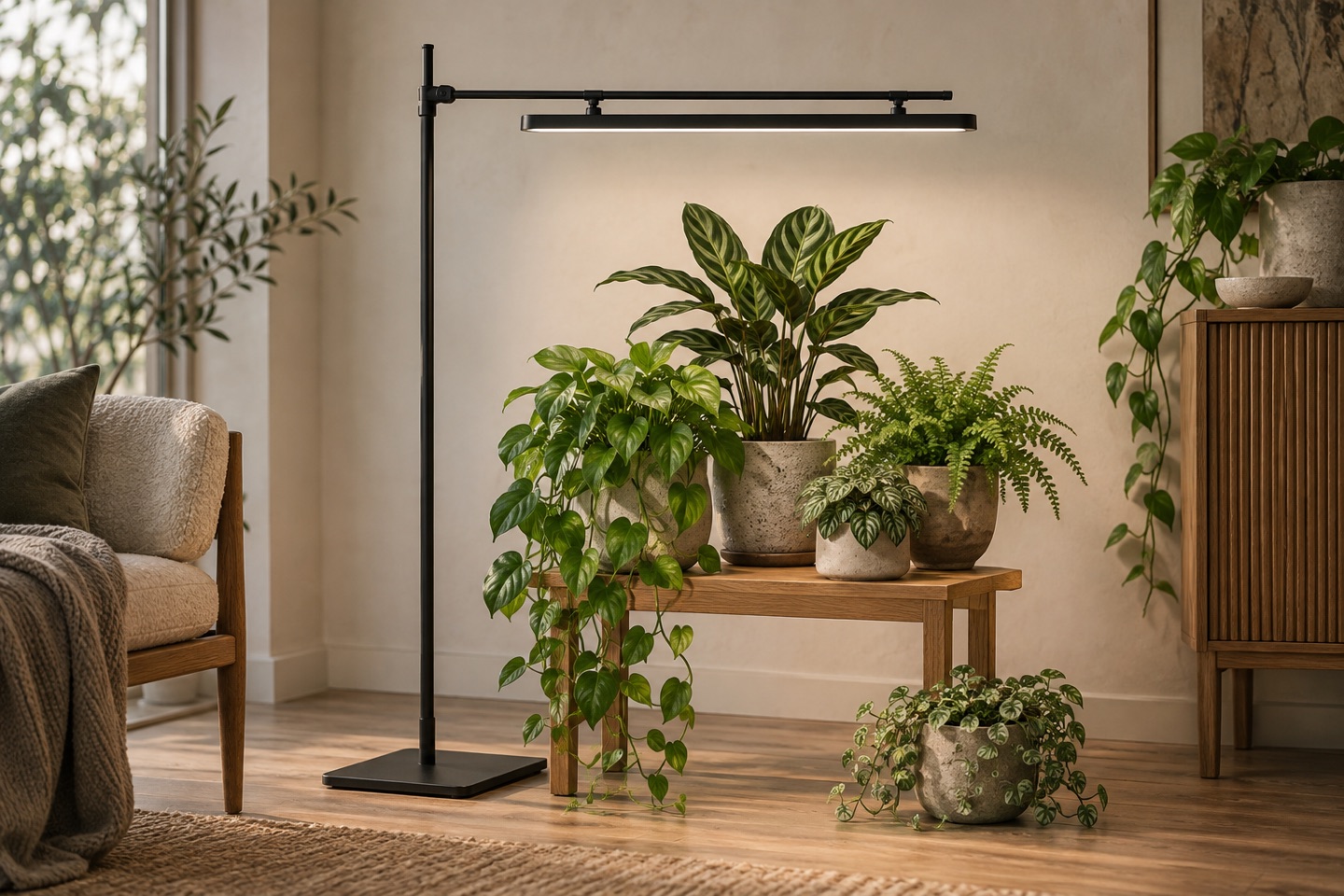
A grow-light stand is useful when the room has no convenient shelf or attachment point above the plants. It gives the fixture a dedicated support and can make a growing station easier to move or adjust. The catch is that the advertised maximum height tells you only part of whether it fits.
Before buying, plan the stand, light, plants, and access as one arrangement. You need useful headroom above the foliage, a footprint that belongs in the room, and documented compatibility with the fixture you will hang. This guide walks through those checks and compares two fixture forms that can influence the stand you choose.
As an Amazon Associate I earn from qualifying purchases. Amazon links below are paid links. Read our disclosure.
This guide combines source-based research with practical arrangement advice. We have not conducted hands-on product tests.
List the full supported load
List everything the stand is expected to support: the fixture, its power supply if suspended, hanging components, and any other equipment expressly permitted by the stand instructions. Check the allowed load and connection type before ordering. A light fixture's low-profile appearance does not tell you its complete supported weight.
Keep separate tasks separate. A stand designed to hang a lamp should not automatically become a plant shelf, and a fixture should not hang from decorative furniture hardware without appropriate approval. Check whether the included hooks or brackets match your chosen fixture. The strongest practical benefit of a suitable stand is that it gives the light a predictable position; mismatched attachments undermine that benefit before the lamp is even switched on.
Include the fixture and any attachment hardware the stand must carry. Compare that combination with the manufacturer’s supported attachment type and load rating. A tripod photo is not proof that an unrelated panel can be suspended from it.
If a stand lacks an applicable rating or compatible mount description, leave compatibility unresolved. Our shelf-fit calculator checks dimensions, not structural strength.
Separate maximum height from useful height
Work upward from the surface where the containers will sit. Add the tallest plant or expected crop height, the documented leaf-to-light clearance, the fixture thickness, and the hanging allowance. This gives you a useful height requirement rather than a comparison based only on the top of the stand.
As an illustrative geometry example, a 12-inch plant, 12-inch gap, 2-inch fixture, and 3-inch hanging allowance require 29 inches above the growing surface. Those figures are an example, not approved dimensions for a particular product or plant. Replace them with your own requirements. Check the lowest useful position too: adjustment matters when a seed tray becomes taller or a different plant moves into the station.
The stand’s maximum height is not automatically the light-to-leaf distance. Measure pot and plant height, fixture thickness and any hanging drop. Subtract those from the available height to understand the arrangement.
A 60-inch mounting point above a 36-inch leaf surface leaves 24 inches before subtracting fixture and hanging hardware. That arithmetic describes geometry; it does not establish sufficient or safe light.
Inspect reach and footprint
Mark the stand's base on the floor or table before buying. Include the position of feet, braces, and any crossbar that affects access. You should be able to lift containers and reach controls without stepping over hardware or nudging the support each time.
Check the stand's documented fixture position and stability requirements. A long lamp may extend differently from a small head, and a support's load rating alone does not establish that every off-center arrangement is suitable. Keep cords from creating a pull on the fixture or an obstruction in the room. If the planned base conflicts with a walkway or cabinet, move the growing station rather than judging fit solely by the clear space above the plants.
Check where the fixture sits relative to the stand’s base. An extending arm changes the placement and may have its own load limit. Compare the floor footprint with your room and keep cables clear of ordinary walking routes.
A stand should provide stable approved positioning and access to adjust the light. We have not tested stand stability, grip or load failure and do not label one universally best. Keep exact manufacturer instructions with any purchase comparison.
Choose a fixture that suits this job
Barrina T5 shelf-bar family
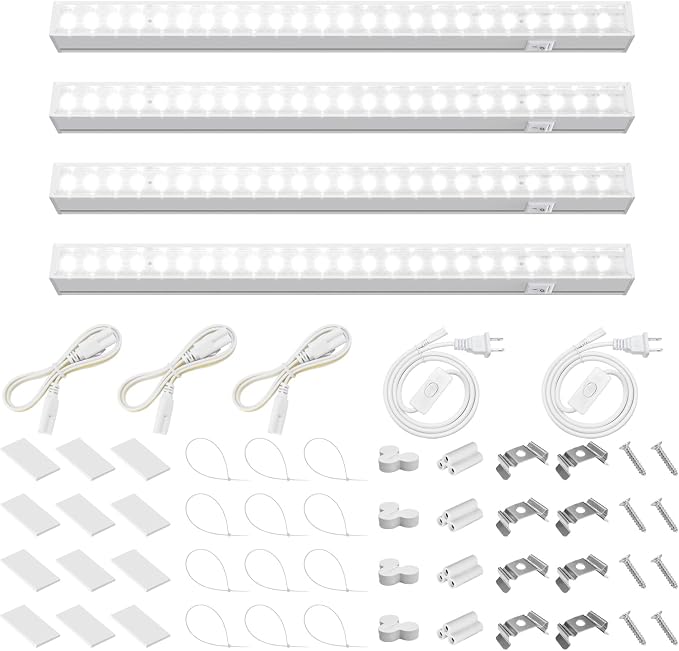
For a compact shelf, the Barrina T5 one-foot, white-cover four-pack is our modular option to compare. Separate bars let you plan their positions around a row of pots or a small tray, rather than placing one spotlight over the middle. The selected listing includes connecting cords and several mounting components, and describes a 20W total across the four bars. Use the exact pack when checking what you need.
This version is non-magnetic; other Barrina listings have different covers and attachment systems. Choose mounting hardware suited to your shelf and follow the surface restrictions in the instructions. For instance, tape has a different job on a smooth panel than on a wire rack. We favor these bars when flexibility in arranging a small shelf matters. The tradeoff is more individual pieces and cables to organize. Do not assume that four bars automatically cover a particular tray: check the intended mounting distance, distribution, and plant requirements before deciding how many to install.
View Barrina T5 shelf-bar family on Amazon (paid link)
Spider Farmer SF600
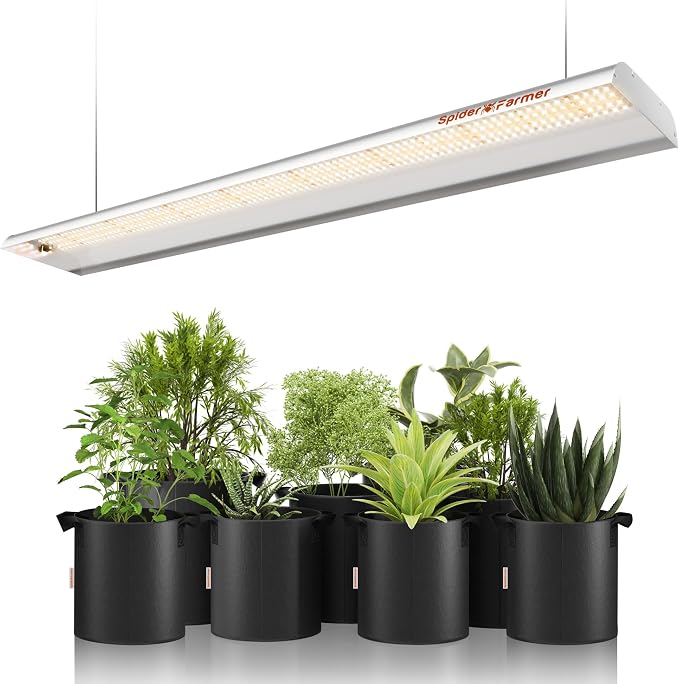
The Spider Farmer SF600 is the longer, integrated fixture to compare for a rectangular growing area. We recommend its form for buyers who would rather hang one long assembly than arrange several separate short bars. That can simplify the physical layout above trays, provided the fixture and hanging hardware fit inside the available space.
Allow room for the power supply, cable exits, and raising or lowering the fixture. Check the current package and its controls instead of assuming it includes a dimmer or timer. External reviews discuss earlier SF600 versions, and the currently observed listing gives different power wording from older documents. For that reason, confirm the current model's input draw before calculating cost, and use its current instructions for mounting. The benefit is the tidy rectangular arrangement; the limitation is that a long fixture is less adaptable to an isolated pot or a narrow furniture corner. A staged product photograph does not establish uniform light across its entire pictured display.
View Spider Farmer SF600 on Amazon (paid link)
Make the setup easy to use
Evaluate a complete arrangement
A good comparison includes the lamp, its mount, the space it occupies, and the routine you will use. Put your proposed fixture into a simple sketch showing the foliage, shelf edges, cord route, and access for watering. Include room to make adjustments. A fixture that technically fits can still be inconvenient when its switch is behind the plants or its cable crosses the area where you lift containers.
Compare two options using the same growing footprint and available mounting height. Keep the model, revision, and controls with any published measurements. If one map was made closer to the light or inside reflective walls, it is not a direct comparison with a map made farther away on an open shelf. Ask for missing conditions before treating a large headline number as useful evidence.
Separate light quantity from power use
PPFD describes light arriving at a surface, while watts describe electrical input. Both are useful, but they answer different questions. Record readings where the leaves sit and look at several positions across the display. A lamp can have a high center reading without distributing that light in the shape you need. Published PPF is overall output; it does not establish a particular leaf-level reading.
For a constant reading, DLI equals PPFD multiplied by daily hours and 0.0036. An illustrative 100 µmol/m²/s for twelve hours therefore gives 4.32 mol/m²/day. This is arithmetic, not a plant recommendation. Changing daylight requires measurements over time, so one noon window reading should not be multiplied by the entire day. Keep biological guidance separate from the calculation.
Include the ongoing expense
A hypothetical 30W light running twelve hours daily for thirty days uses 10.8 kWh. At an assumed $0.15 per kWh, that is $1.62 for the month. Use actual input power and your own tariff, then add mounts, compatible bulbs, and any timer to the upfront comparison. A cheaper lamp that needs additional fixtures may become a more expensive complete setup. Decide what meets the task before deciding which price looks best.
Choose the fixture and stand as a pair
For a compact shelf-sized station without an overhead surface, decide whether several short bars can be mounted in the way their instructions allow. The Barrina pack includes multiple attachment components, but that does not mean it can hang from any stand. Plan the approved arrangement and the cable connections together.
For a rectangular tray station, a compatible support for the Spider Farmer SF600 can simplify positioning one long fixture. Measure its current dimensions and hanging requirements, then compare the stand's useful interior space and attachment system. Include the power supply and clearance. A single fixture can make the station feel orderly when the support was chosen for it.
For a decorative single-plant display, start with a fixture and support intended for that role rather than adapting a tray stand because it is tall enough. The room's normal use matters: a broad support might fit physically while feeling intrusive beside a chair. Make a rough floor outline and think through watering access before purchasing. No specific stand is ranked here because we have not yet verified an exact stand listing, manual, and fixture combination.
Our recommendation
Choose a grow-light stand from the complete supported arrangement, its useful height range, and its base footprint. A suitable stand can make a dedicated growing station easier to organize and adjust, provided its documented attachments match the fixture.
Measure from the growing surface, include all hanging allowances, and preserve access for normal care. Compare the stand and lamp together before comparing prices. Our fixture examples help define that decision, but they are not endorsements of an unverified stand. Buy a documented combination that fits the job rather than assuming the tallest support is automatically the most useful.
When you are ready to compare listings, consider Barrina T5 1FT white-cover four-pack (paid link) for a modular compact shelf; Spider Farmer SF600 (paid link) for a longer rectangular growing station. Check the selected version and included components before ordering.
Research sources and scope
Plant guidance comes from the references below. Fixture links accompany the relevant recommendations. Arrangement examples and purchasing advice are our analysis. We report no hands-on product trials or independently measured growing footprints.
- Supplemental-light considerations — Iowa State Extension ↗Reviewed 2026-09-27
- Independent Barrina review; longer version, not an exact one-foot test ↗Reviewed 2026-09-27
- Independent SF300/SF600 measurements; earlier versions and stated test conditions ↗Reviewed 2026-09-27
- SF600 setup review; gifted unit and affiliate disclosure, numerical claims excluded ↗Reviewed 2026-09-27