Bringing hibiscus indoors: choosing supplemental lighting
Bringing a hibiscus indoors is a seasonal move with more decisions than finding a vacant corner. You need room for the plant, a suitable winter-care plan, and a lighting arrangement that matches what you want to maintain. A lamp can supplement the indoor location, but it cannot make every overwintering approach equivalent.
We recommend deciding first whether you are keeping a tropical hibiscus as a leafy indoor plant or following an appropriate dormant-storage plan. For the bright indoor-plant route, compare a compatible bulb arrangement with a longer fixture for a dedicated growing area. This guide focuses on the practical lighting purchase while keeping plant identity and seasonal care separate.
As an Amazon Associate I earn from qualifying purchases. Amazon links below are paid links. Read our disclosure.
This guide combines source-based research with practical arrangement advice. We have not conducted hands-on product tests.
Confirm what plant is coming inside
Check the label before choosing winter lighting. Tropical hibiscus and other plants sold under the same broad name do not necessarily share the same overwintering requirements. Keep the botanical identity with the care reference, and decide which seasonal approach applies to your plant before buying equipment.
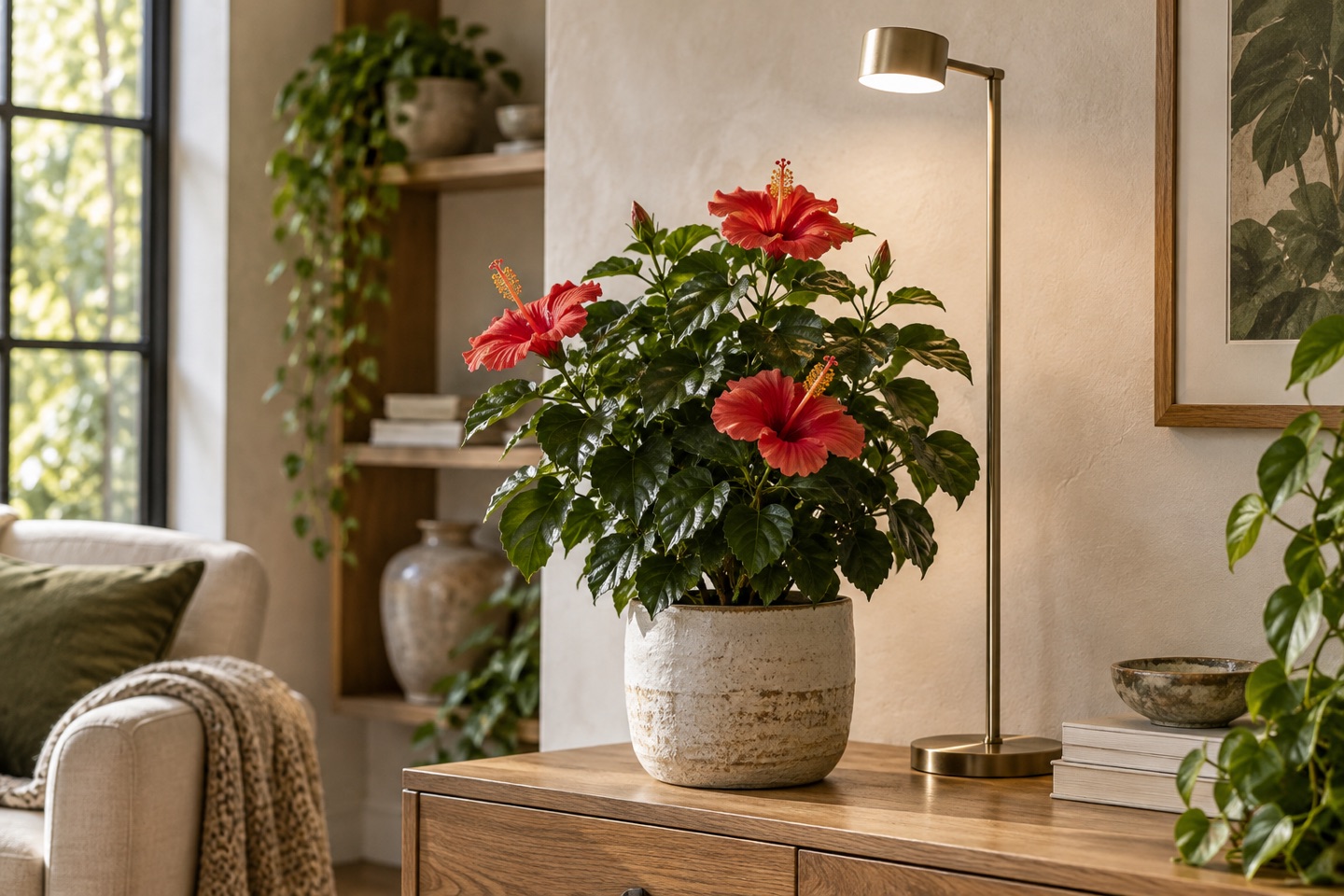
If you want to keep a tropical hibiscus as an indoor plant, plan its location while there is still time to make the move deliberately. A large pot and spreading branches can require more floor space than you expect. Look for a suitable bright location and sketch the lamp around the canopy rather than simply placing it beside the container. Do not plan your purchase around a guarantee of winter flowers.
Tropical hibiscus and hardy garden hibiscus are different plants. Keep the plant’s identity with your plan instead of applying an indoor lamp recommendation to everything called hibiscus. University of Maryland Extension discusses bringing tropical plants such as hibiscus into a bright indoor location.
This guide focuses on arranging supplemental light for the indoor plant. It does not prescribe dormancy care for unrelated hardy species or guarantee winter flowers.
Measure the mature canopy
Measure the canopy in its intended indoor location, including branches extending toward furniture or a doorway. Leave space to inspect the plant and reach the pot. A lighting station that only works when you push the hibiscus tightly into a corner is likely to be inconvenient throughout winter.
Consider where the plant will go after the season, too. A temporary winter station may favor removable mounting, while a dedicated room can accommodate a longer fixture more comfortably. If the lighting equipment must be stored later, include that in your comparison. The advantage of an adjustable arrangement is that you can adapt it to the seasonal task without permanently reorganizing the room.
A patio plant can occupy considerably more width than a small desk plant. Draw its broadest branches, highest foliage and the useful window position. Leave access to inspect and water the pot after the lamp is installed.
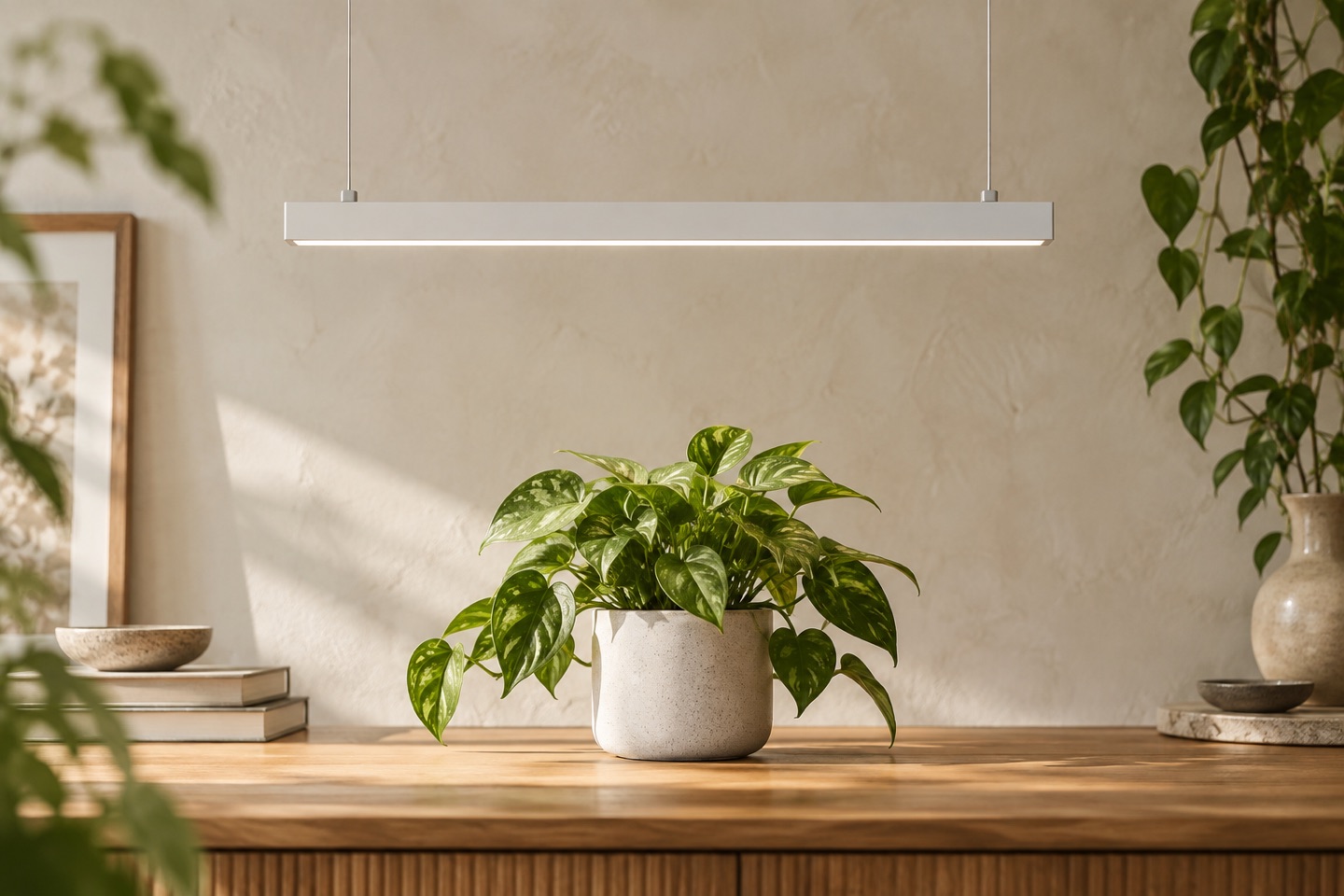
An overhead fixture needs a support and a map that describe your growing area. A plant bulb in a suitable stand may offer another arrangement, but evaluate coverage across the branches rather than only the top leaf.
Treat seasonal moves as a new setup
Make a moving checklist that includes the lighting installation and the rest of the plant's care. The Maryland reference discusses indoor conditions and monitoring for pests; a new lamp does not remove those responsibilities. Inspect the plant regularly rather than treating its appearance as a direct readout of the fixture's quality.
Keep a dated record of the move, lamp position, and routine. If leaves change after the move, that record helps you examine several changed conditions rather than immediately increasing the lighting hours. Plan the station so checking the leaves and pot is easy. A successful winter arrangement should support ordinary care and inspection, not merely put a bright fixture above the plant.
The light pattern outside does not transfer unchanged to a room. Record the indoor arrangement and monitor other conditions that change with the move. Leaf drop or poor flowering does not establish one specific light problem by itself.
Budget using actual power for the intended schedule. If a fixture lacks usable output documentation, do not promise that its wattage will maintain flowers. Keep the limitation visible when comparing models.
Choose a fixture that suits this job
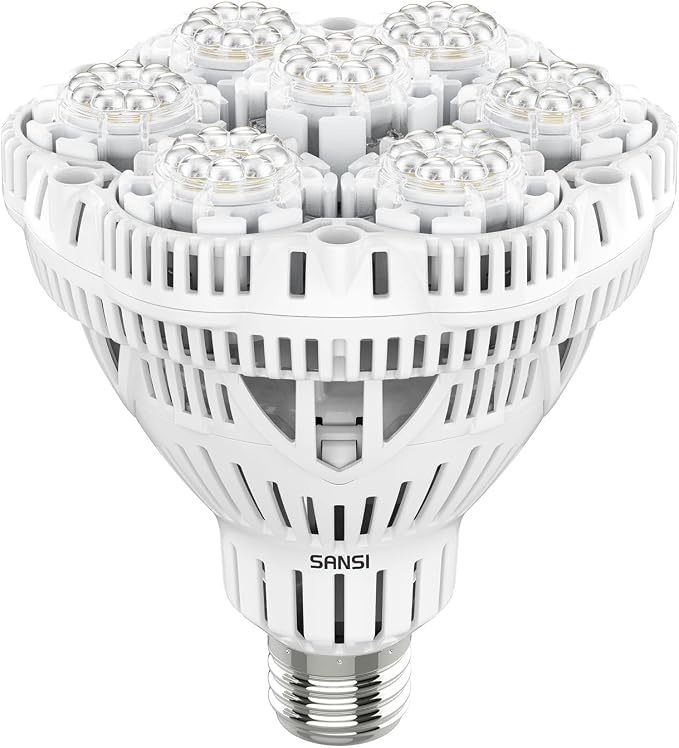
SANSI BR30 36W grow bulb
The SANSI BR30 36W bulb is our screw-in option to compare when you want to choose your own suitable fixture. Its appeal is flexibility: a separately purchased lamp can give you the reach, base position, and visual style that work in your room. The US version uses an E26 base, but matching that base is only the first compatibility check.
Compare bulb dimensions, fixture rating, approved orientation, ventilation, and the manufacturer's instructions before combining them. Do not place this 36W bulb in SANSI's 10W clip-on assembly. An open, compatible fixture may suit your plans better than trying to hide a large bulb inside an unsuitable shade. We recommend this route to buyers willing to check the complete combination; a ready-made plant lamp is simpler when you want fewer compatibility decisions. Use the exact BR30 documentation when evaluating output, because an older review of a similarly named SANSI bulb may describe another design.
View SANSI BR30 36W grow bulb on Amazon (paid link)
Spider Farmer SF600
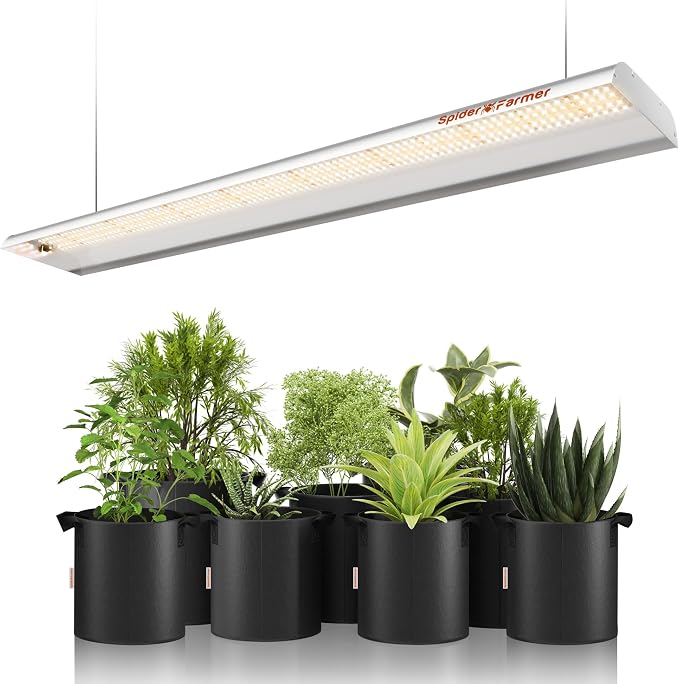
The Spider Farmer SF600 is the longer, integrated fixture to compare for a rectangular growing area. We recommend its form for buyers who would rather hang one long assembly than arrange several separate short bars. That can simplify the physical layout above trays, provided the fixture and hanging hardware fit inside the available space.
Allow room for the power supply, cable exits, and raising or lowering the fixture. Check the current package and its controls instead of assuming it includes a dimmer or timer. External reviews discuss earlier SF600 versions, and the currently observed listing gives different power wording from older documents. For that reason, confirm the current model's input draw before calculating cost, and use its current instructions for mounting. The benefit is the tidy rectangular arrangement; the limitation is that a long fixture is less adaptable to an isolated pot or a narrow furniture corner. A staged product photograph does not establish uniform light across its entire pictured display.
View Spider Farmer SF600 on Amazon (paid link)
Make the setup easy to use
Make the timer fit the room
A routine that runs without daily reminders is one of the best practical improvements you can make. Decide when you want the display illuminated and when you want the room dark, then check that the schedule fits the plant's care guidance. The lamp should help you enjoy the room rather than become something you repeatedly switch off because it interferes with reading, work, or sleep.
Confirm how the exact fixture behaves after the timer removes and restores power. An electronic control that needs another button press can frustrate an otherwise sensible plan. Keep the switch accessible after routing the cord. If reaching it means moving three pots, change the arrangement before you settle into regular use.
Track the arrangement, not just the switch
Record the light position, daily schedule, and date of installation. Take a reference photograph in consistent ordinary lighting, then use later pictures and new growth to evaluate your care routine. A photograph is a record, not a calibrated measurement, and a change in the plant does not prove that the lamp caused it. Keep watering, temperature, and other care observations alongside the lighting notes.
If you measure output, record the reading at foliage height and the lamp setting. Check the outer leaves as well as the center. PPFD describes light arriving at an area; a manufacturer's PPF figure describes overall output and cannot replace those placement details. A reading made with a phone also needs the appropriate settings or calibration for its light source. Preserve that context so a later adjustment is a comparison you can understand.
Estimate the complete running cost
Use actual input watts for every lamp you will operate. As an illustration, a 20W arrangement running twelve hours daily for thirty days uses 7.2 kWh. At an assumed $0.15 per kWh, that is $1.08. Replace both numbers with your planned power draw and local tariff. This estimate excludes purchase cost and other equipment; it is not a quoted bill or a recommended schedule. Our light-and-cost calculator makes that arithmetic easier when you are comparing two complete setups.
Choose a seasonal arrangement with a clear purpose
For one tropical hibiscus beside a useful window, a suitable separately positioned bulb fixture is worth comparing as supplemental lighting. Check the bulb and lamp compatibility together, and plan the direction and clearance around the canopy. An accessible switch and repeatable schedule can simplify the seasonal routine.
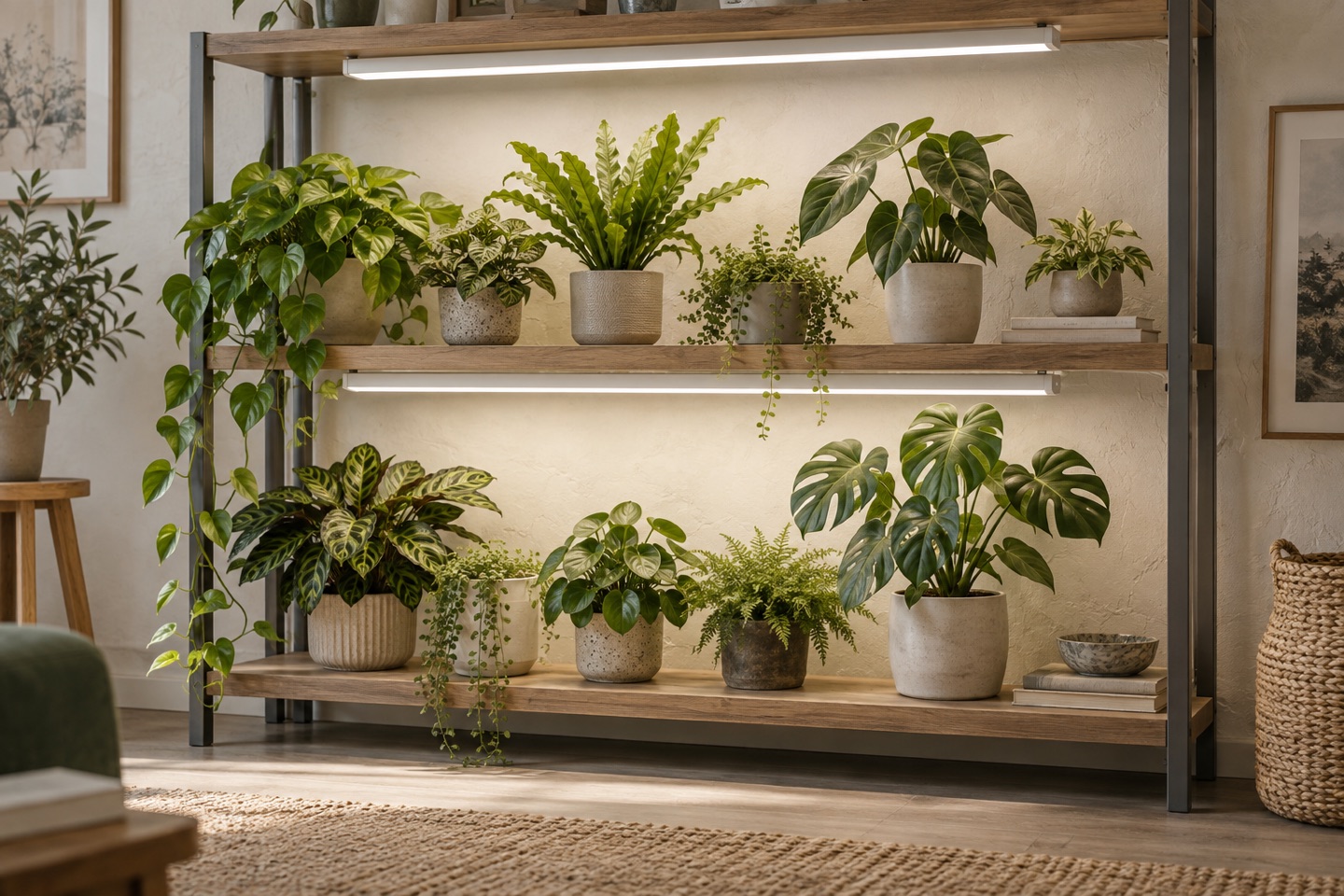
For several plants in a dedicated indoor area, a longer fixture may create a more organized station. Compare the actual foliage footprint and the current fixture documentation rather than assuming that a row of pots has uniform height. Leave room to adjust individual positions as the plants change.
For a plant following an appropriate dormant-storage approach, buying the same bright growing installation may not match the care plan. Resolve that question with the species guidance before spending. This is where identifying the seasonal goal saves you from buying equipment for a task you are not trying to perform. Light selection should follow the overwintering decision rather than decide it for you.
Our recommendation
For a tropical hibiscus kept as a leafy indoor plant, choose supplemental lighting that fits the canopy and the winter-care location. We recommend the compatible bulb route for one flexible position and a longer fixture for a dedicated area when its documented arrangement suits the plants.
Before buying, confirm plant identity, choose the overwintering approach, measure the canopy, and check the mounting position. Keep the rest of the seasonal care plan in place. A practical winter station is a worthwhile investment when it serves that clear purpose; no fixture alone promises continuous flowers or solves every change caused by moving indoors.
When you are ready to compare listings, consider SANSI BR30 36W grow bulb (paid link) for a compatible lamp you choose separately; Spider Farmer SF600 (paid link) for a longer rectangular growing station. Check the selected version and included components before ordering.
Research sources and scope
Plant guidance comes from the references below. Fixture links accompany the relevant recommendations. Arrangement examples and purchasing advice are our analysis. We report no hands-on product trials or independently measured growing footprints.
- Overwintering tropical plants — University of Maryland Extension ↗Reviewed 2026-09-27
- Iowa State Extension: supplemental indoor light and measurement concepts ↗Reviewed 2026-09-27
- Independent SANSI brand review; exact BR30 performance not established ↗Reviewed 2026-09-27
- Independent SF300/SF600 measurements; earlier versions and stated test conditions ↗Reviewed 2026-09-27
- SF600 setup review; gifted unit and affiliate disclosure, numerical claims excluded ↗Reviewed 2026-09-27