Grow lights for Monstera: cover a tall, wide plant
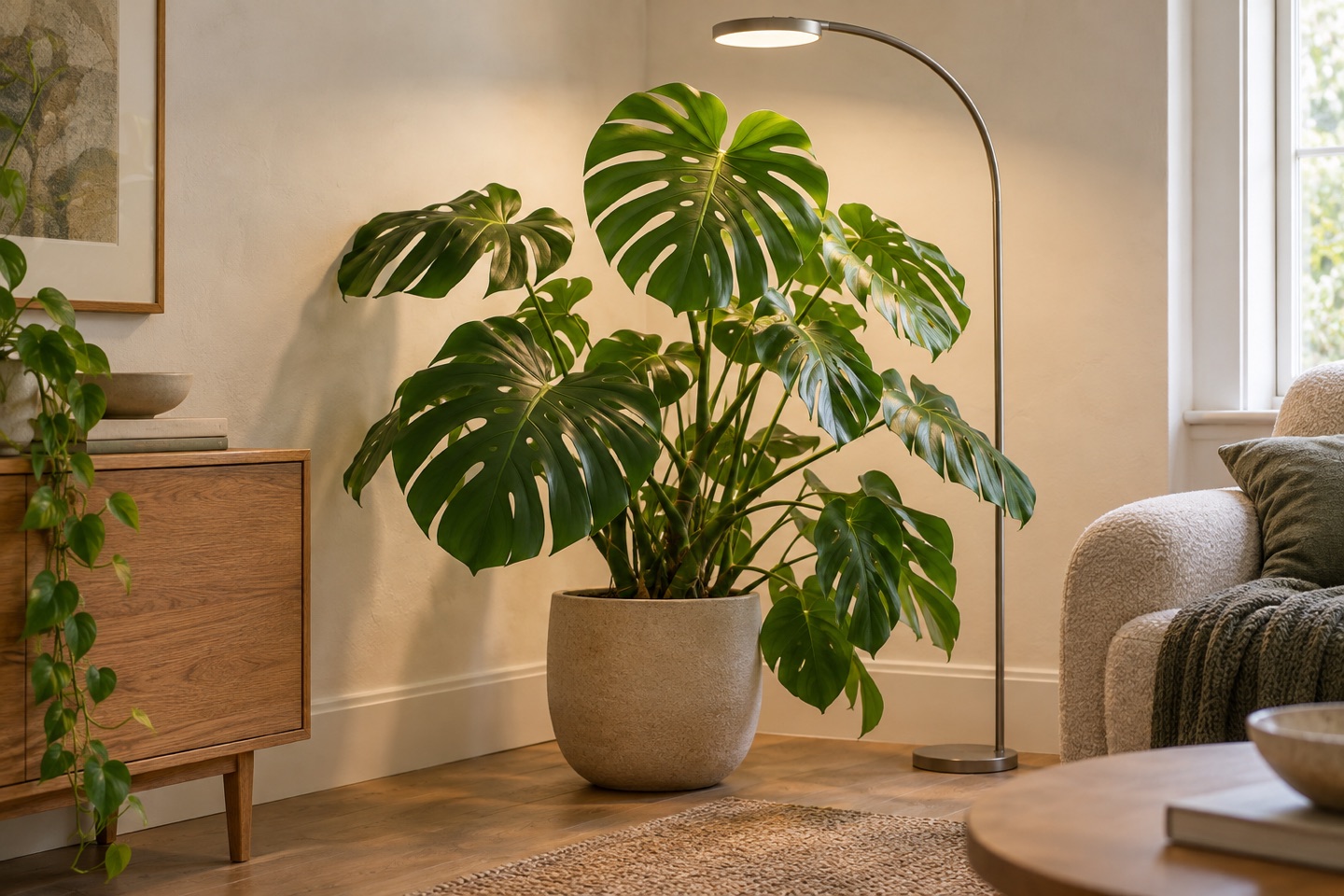
A Monstera can look excellent in a living-room corner while its leaves extend far beyond the spot where a small lamp would shine. That makes grow-light shopping a different task from lighting a little pot on a desk. You are arranging light around a climbing, spreading plant, and the useful position can change as the plant grows.
Our recommendation is to plan the canopy and mounting point together. An adjustable clip light is a practical option for a compact young plant; a suitable bulb fixture or decorative pendant deserves comparison when the plant becomes a larger room feature. This guide explains how to choose among those arrangements without mistaking a bright spot over the pot for coverage across the leaves.
As an Amazon Associate I earn from qualifying purchases. Amazon links below are paid links. Read our disclosure.
This guide combines source-based research with practical arrangement advice. We have not conducted hands-on product tests.
Treat the plant as a three-dimensional shape
Look at your Monstera from the front and the side. The plant's widest leaves may extend toward the window, while the newest leaf sits higher on its support. Include both in your drawing. If you only measure pot diameter, you can underestimate the space the lighting arrangement needs to serve.
For a young plant on a table, check whether a clamp arm can put its head in a useful position without crossing the route you use to water. For a taller plant beside a sofa, look for a mounting arrangement that can move with the canopy rather than a short arm anchored far below it. Revisit the sketch when you add a support or move the pot: both changes can affect which leaves sit closest to the lamp.
Measure the canopy width and the heights of its highest and lowest exposed leaves. A tall climbing plant can put its newest leaf much nearer an overhead lamp than its lower leaves. A single distance written on a product page will not describe every part of that canopy.
Sketch the lamp position, support and outer leaves. Leave room for the next leaf and for access to the pot. If the lamp arm cannot reach the useful part of the canopy, increasing its advertised output does not solve the positioning problem.
Use plant identity as a starting point
Keep the plant's identity with the care information you use. A broad shopping search can mix Monstera species, cultivars, and unrelated plants sold under similar common names. A useful starting record is the name on the original label, a current photograph, and the care reference you intend to follow.
Avoid making one dramatic leaf the sole goal of the purchase. The useful question is whether you can provide a consistent, appropriate growing environment for your plant. Decide whether the lamp supplements a bright window or becomes the main light in a darker corner. That distinction changes how much confidence you need in the proposed output and coverage, even when the fixture looks equally attractive in both locations.
NC State Extension describes Monstera deliciosa as a climbing plant that prefers moderate brightness rather than direct sunlight. That is useful context, not an exact leaf-level PPFD target. Do not assume an unverified numerical range is appropriate for every variegated cultivar.
Keep a plant label or photograph of its identifying features in your own records. Confusing a Monstera with a philodendron can send you to the wrong care reference.
Compare fixtures by arrangement
Treat mounting as a design choice with consequences. A clip lamp can be moved with the display and occupies little tabletop space. A bulb in a compatible floor or hanging fixture gives you different positions to work with. A decorative pendant can create a pleasing permanent arrangement but needs a suitable attachment point and cord route.
For a plant beside a reading chair, check the seated view before choosing a lamp. For a plant on a narrow stand, make sure the light does not obstruct moving the pot. For a larger specimen, leave space for the next leaf rather than positioning everything tightly around the current outline. Choose the arrangement you can comfortably keep in place each day.
An adjustable lamp can serve a small plant if its reach and footprint suit the canopy. A bulb in a suitable rated fixture offers more mounting choices, but base compatibility alone does not establish safe ventilation. A hanging fixture needs an appropriate support and a documented distribution map.
Measure again after moving the plant or raising its support. We do not claim that a particular fixture guarantees large leaves or fenestration; those outcomes cannot be established from its specification sheet.
Choose a fixture that suits this job
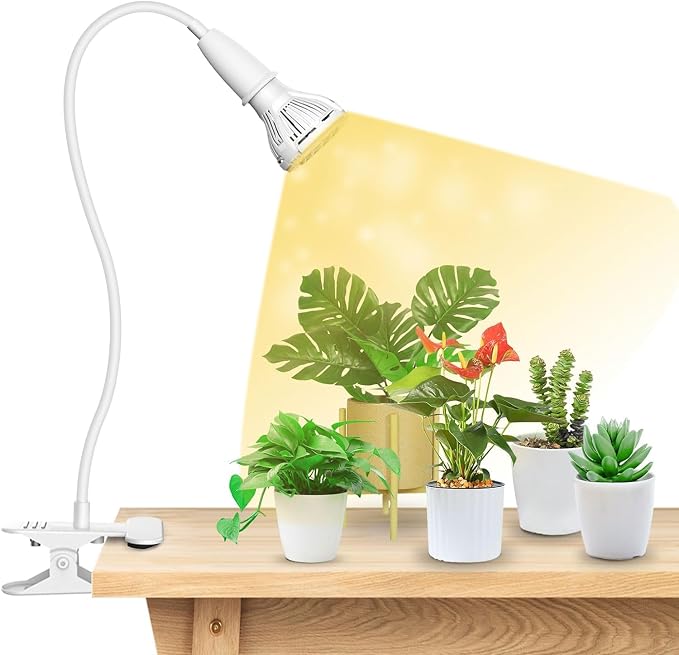
SANSI 10W adjustable clip-on
For one compact plant display, we recommend the SANSI one-head 10W clip-on as an adjustable option when the furniture provides a suitable mounting edge. The clamp leaves the surface available for the pot, while the arm lets you position the head independently of that attachment point. That is particularly useful beside a desk or a small plant stand where another lamp base would be inconvenient.
The bulb can be replaced separately, giving you a component to change rather than necessarily replacing the whole fixture. Check compatible replacements and the fixture rating before ordering a different bulb. Plan the arrangement around the plant's foliage and leave the required clearance: SANSI's precautions specify at least one foot and warn against touching the operating bulb. For a wide display, choose a wider lighting arrangement rather than expecting this small head to reach every plant. We have not established its exact growing footprint through independent measurements.
View SANSI 10W adjustable clip-on on Amazon (paid link)
SANSI BR30 36W grow bulb
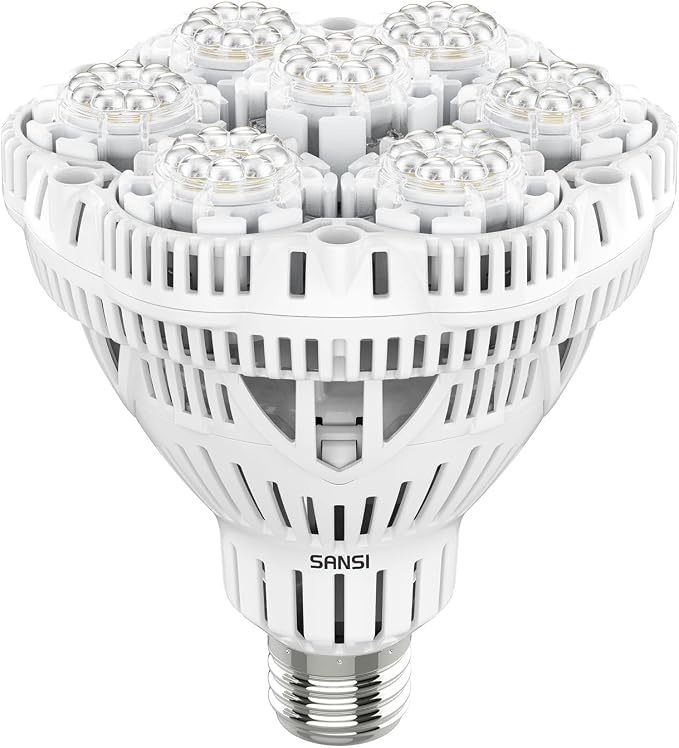
The SANSI BR30 36W bulb is our screw-in option to compare when you want to choose your own suitable fixture. Its appeal is flexibility: a separately purchased lamp can give you the reach, base position, and visual style that work in your room. The US version uses an E26 base, but matching that base is only the first compatibility check.
Compare bulb dimensions, fixture rating, approved orientation, ventilation, and the manufacturer's instructions before combining them. Do not place this 36W bulb in SANSI's 10W clip-on assembly. An open, compatible fixture may suit your plans better than trying to hide a large bulb inside an unsuitable shade. We recommend this route to buyers willing to check the complete combination; a ready-made plant lamp is simpler when you want fewer compatibility decisions. Use the exact BR30 documentation when evaluating output, because an older review of a similarly named SANSI bulb may describe another design.
View SANSI BR30 36W grow bulb on Amazon (paid link)
Soltech Aspect Gen 2
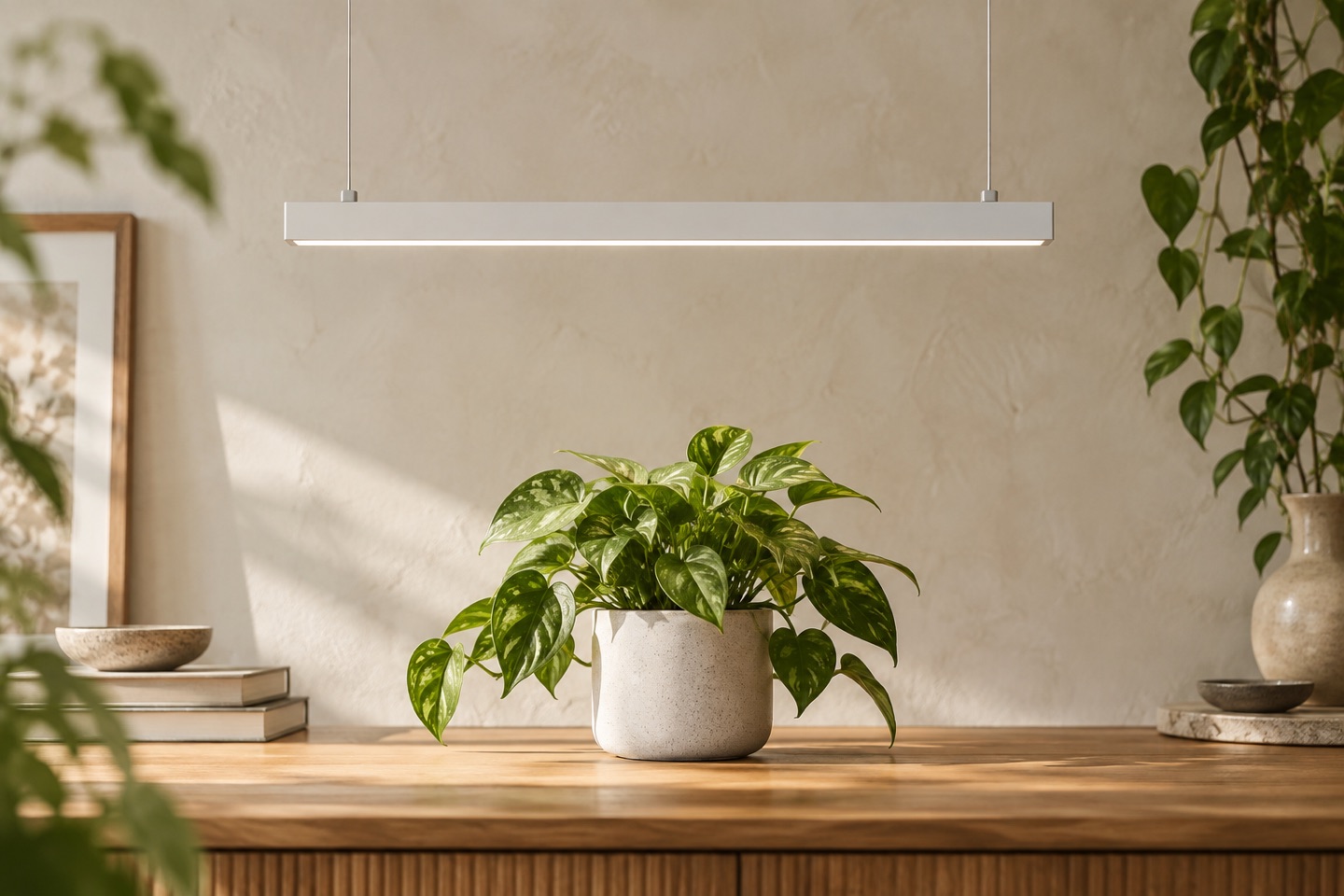
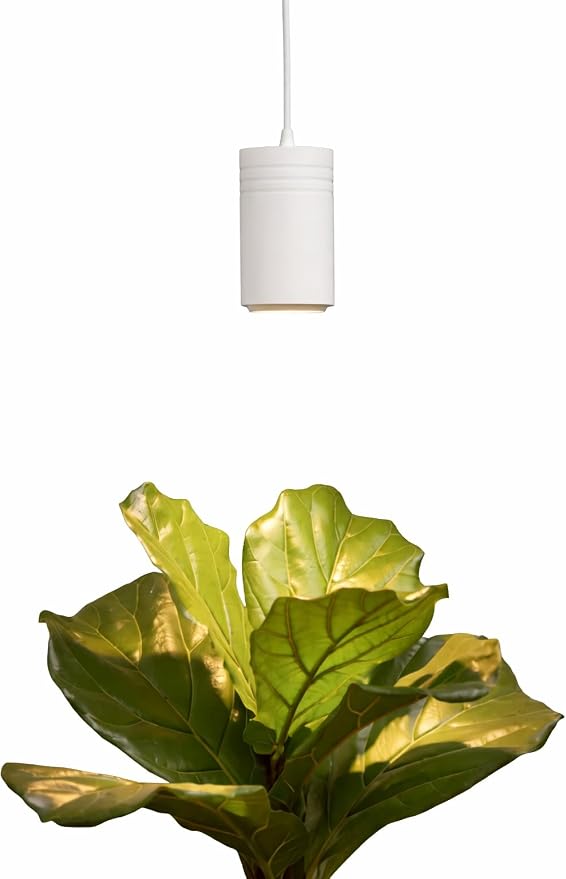
For a light that will remain visible in a living room, we recommend comparing the Soltech Aspect Gen 2 pendant. Its cylindrical housing and suspended placement make the lighting part of the display rather than an accessory clipped to the furniture. The current listing describes warm-white light and an on-cord dimmer, useful features when you want to adjust the room's appearance as well as the plant arrangement.
The purchase requires a suitable hanging point and a planned cord route. Think through installation before choosing a position above your favorite plant, especially in a rented room. The Amazon package currently says no timer is included, while Soltech’s direct US/Canada package lists an outlet timer. Check the exact seller’s package before buying a separate timer. We recommend the Aspect for someone who values an integrated decorative fixture; it makes less sense when you only need inexpensive lighting hidden beneath a shelf. Its integrated LED also differs from the separately replaceable bulb approach. Compare support terms and mounting instructions for the exact generation you select.
View Soltech Aspect Gen 2 on Amazon (paid link)
Make the setup easy to use
Make the timer fit the room
A routine that runs without daily reminders is one of the best practical improvements you can make. Decide when you want the display illuminated and when you want the room dark, then check that the schedule fits the plant's care guidance. The lamp should help you enjoy the room rather than become something you repeatedly switch off because it interferes with reading, work, or sleep.
Confirm how the exact fixture behaves after the timer removes and restores power. An electronic control that needs another button press can frustrate an otherwise sensible plan. Keep the switch accessible after routing the cord. If reaching it means moving three pots, change the arrangement before you settle into regular use.
Track the arrangement, not just the switch
Record the light position, daily schedule, and date of installation. Take a reference photograph in consistent ordinary lighting, then use later pictures and new growth to evaluate your care routine. A photograph is a record, not a calibrated measurement, and a change in the plant does not prove that the lamp caused it. Keep watering, temperature, and other care observations alongside the lighting notes.
If you measure output, record the reading at foliage height and the lamp setting. Check the outer leaves as well as the center. PPFD describes light arriving at an area; a manufacturer's PPF figure describes overall output and cannot replace those placement details. A reading made with a phone also needs the appropriate settings or calibration for its light source. Preserve that context so a later adjustment is a comparison you can understand.
Estimate the complete running cost
Use actual input watts for every lamp you will operate. As an illustration, a 20W arrangement running twelve hours daily for thirty days uses 7.2 kWh. At an assumed $0.15 per kWh, that is $1.08. Replace both numbers with your planned power draw and local tariff. This estimate excludes purchase cost and other equipment; it is not a quoted bill or a recommended schedule. Our light-and-cost calculator makes that arithmetic easier when you are comparing two complete setups.
Three Monstera setups worth comparing
For a small plant on a desk, we favor starting with the adjustable clip arrangement if it can reach the foliage and preserve the required clearance. Its appeal is convenience, not a claim that every Monstera needs exactly that lamp. When the canopy outgrows the arrangement, reassess the light rather than forcing the head into an awkward position.
For a plant on a floor stand beside a bright window, a compatible bulb fixture can provide another mounting option. Plan the lamp around the available natural light and the plant's shape, and check fixture suitability before buying the bulb. Avoid treating an E26 socket as proof that a shade or enclosure is appropriate.
For a larger plant that is part of the room's decor, the Aspect Gen 2 is the decorative option to compare. Its hanging position and dimmer give you different design choices from a clip lamp. Account for installation and ongoing adjustment as the plant changes height. Choose it when you value that complete arrangement; a hidden shelf installation does not need the same decorative hardware.
Our recommendation
Choose the light around your Monstera's canopy, the available mounting position, and the role daylight already plays. We recommend the clip-on route for a compact setup, a compatible bulb arrangement for flexibility, and a decorative pendant when the fixture will become part of the room.
Before ordering, measure the outer leaves, check clearance above the highest leaf, sit in the nearby chair to assess the sightline, and leave room for future growth. If you need a defined coverage area, prioritize current measurements for the exact model. A well-positioned fixture is a useful addition; an attractive lamp that cannot reach the foliage is an expensive compromise.
When you are ready to compare listings, consider SANSI 10W adjustable clip-on (paid link) for an adjustable compact display; SANSI BR30 36W grow bulb (paid link) for a compatible lamp you choose separately; Soltech Aspect Gen 2 (paid link) for a visible decorative pendant. Check the selected version and included components before ordering.
Research sources and scope
Plant guidance comes from the references below. Fixture links accompany the relevant recommendations. Arrangement examples and purchasing advice are our analysis. We report no hands-on product trials or independently measured growing footprints.
- Monstera deliciosa — NC State Extension ↗Reviewed 2026-09-27
- Iowa State Extension: supplemental indoor light and measurement concepts ↗Reviewed 2026-09-27
- Independent review: SANSI multi-head clip-on; model differs ↗Reviewed 2026-09-27
- Independent SANSI brand review; exact BR30 performance not established ↗Reviewed 2026-09-27
- Aspect Gen 2 review; paid partnership and affiliate disclosure ↗Reviewed 2026-09-27