Orchid grow lights: choose by orchid group
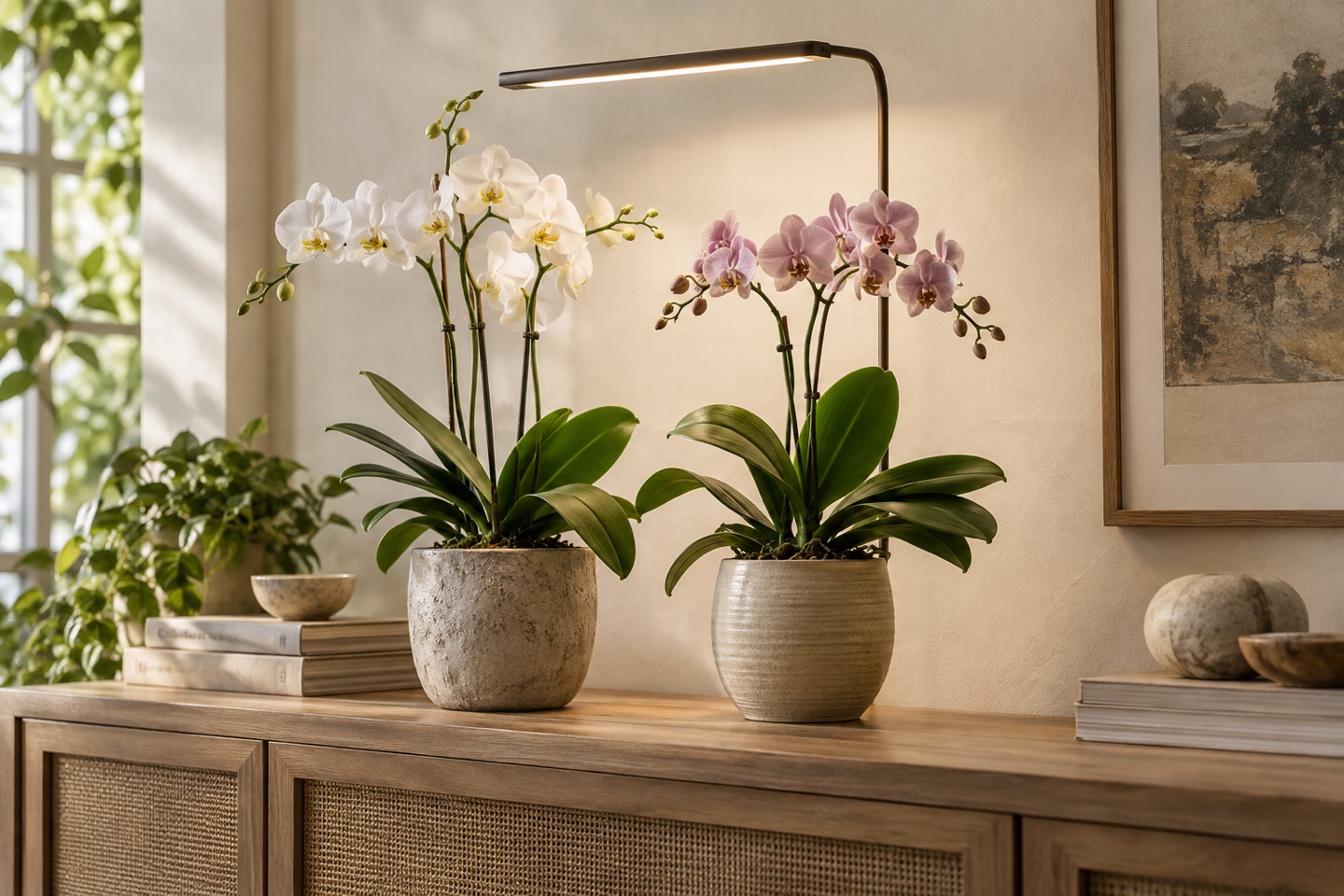
An orchid collection often grows faster than the shelf planned for it. The first plant fits neatly beneath a lamp; a taller flower spike or a different orchid group can turn that simple arrangement into a puzzle. Grow-light shopping works better when you plan for the collection's shapes and care differences before comparing fixtures.
We recommend adjustable linear lighting for a shelf of suitable orchids, with enough clearance to accommodate the plants and their changing display. Short bars offer layout flexibility, while a longer hanging fixture suits an uninterrupted growing area. This guide focuses on arranging and choosing lights; use orchid-group guidance to decide what your actual plants need.
As an Amazon Associate I earn from qualifying purchases. Amazon links below are paid links. Read our disclosure.
This guide combines source-based research with practical arrangement advice. We have not conducted hands-on product tests.
Start with the orchid’s identity
Make a list of the orchids before moving them into one lighting area. Write down the group or species when you know it, the current plant height, and whether a spike would extend above the leaves. A collection should not become a single lighting category merely because every pot came from the orchid section of a shop.
If the names are uncertain, resolve them using a reliable label or orchid reference before choosing a demanding lighting program. This matters when a general shopping page suggests one schedule or mounting height for every orchid. Keep the biological requirement separate from the physical shelf choice. The fixture can be versatile without making every plant's care interchangeable.
Keep the nursery label and use an orchid-group care reference. The American Orchid Society offers a guide to growing orchids under lights and group-specific culture information. A broad orchid guide should not turn different genera into one universal target.
If your goal is flowering, say so explicitly in your notes. Keeping a plant alive and producing dependable blooms are different objectives. This guide does not assign an optimum PPFD to unidentified orchids.
Design around pots and leaves
Put the largest leaf spread and tallest relevant growth into your shelf sketch. A plant may fit under a shelf while its flower spike does not. Decide whether you can move it to another position when it needs more room, or whether the rack should have a taller tier from the beginning.
Leave access to remove each pot for the care method you use. If you take plants away from the shelf for watering, make sure the route does not catch a leaf or spike on the lamp. If the collection includes very different heights, group compatible plants in separate areas rather than lowering one fixture over everything. A shelf with fewer plants and workable access can be easier to maintain than a densely filled display.
Measure the broadest leaf spread, pot height and clearance beneath the next shelf. A row of small pots can still occupy a wide canopy. Arrange the leaves before selecting a lamp; the useful footprint is the foliage that receives light, not the tray beneath it.
An adjustable shelf light makes it easier to separate plants of different heights. Do not place a much taller plant directly under the most intense part of a fixture while assuming the entire collection receives the same exposure.
Preserve the measurement context
Compare the fixtures using the growing area you actually intend to light. Record the mounting height and the coverage evidence together; do not select the highest reading from a product page without checking where it was measured. Follow the current fixture instructions for minimum clearances and approved installation.
For a small collection, short bars can let you organize distinct shelf spaces. For a larger continuous row, a longer fixture may reduce the number of individual components. Neither form chooses the orchid care for you. If an output or schedule recommendation conflicts with guidance for your group, resolve that conflict before installing it. A tidy arrangement is useful only when it accommodates the plants it was built to hold.
When comparing published maps, keep the fixture model, height and tested area together. A quoted PPFD value without those details is not enough to approve an orchid shelf. Check leaf-level readings across the arrangement when possible.
Record plant response without interpreting every change as light deficiency. Water, temperature and root condition still matter. Avoid buying a stronger lamp solely because a single plant has not flowered yet.
Choose a fixture that suits this job
Barrina T5 shelf-bar family
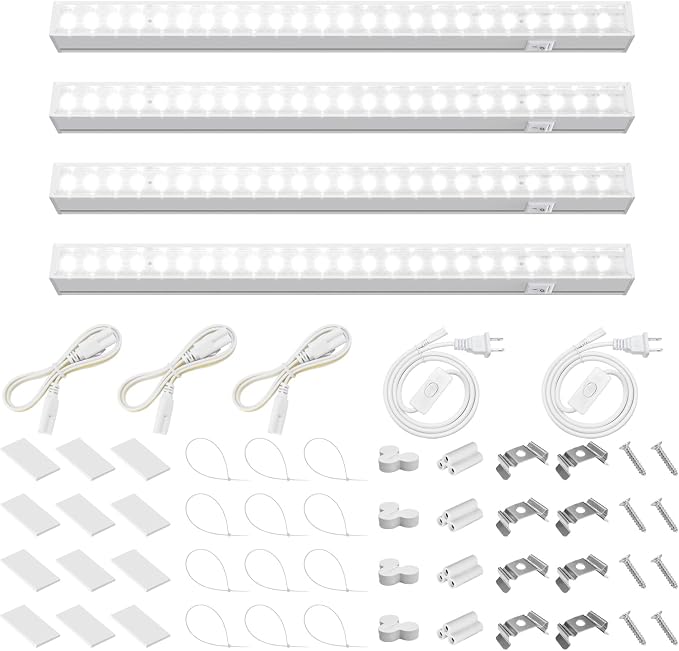
For a compact shelf, the Barrina T5 one-foot, white-cover four-pack is our modular option to compare. Separate bars let you plan their positions around a row of pots or a small tray, rather than placing one spotlight over the middle. The selected listing includes connecting cords and several mounting components, and describes a 20W total across the four bars. Use the exact pack when checking what you need.
This version is non-magnetic; other Barrina listings have different covers and attachment systems. Choose mounting hardware suited to your shelf and follow the surface restrictions in the instructions. For instance, tape has a different job on a smooth panel than on a wire rack. We favor these bars when flexibility in arranging a small shelf matters. The tradeoff is more individual pieces and cables to organize. Do not assume that four bars automatically cover a particular tray: check the intended mounting distance, distribution, and plant requirements before deciding how many to install.
View Barrina T5 shelf-bar family on Amazon (paid link)
Spider Farmer SF600
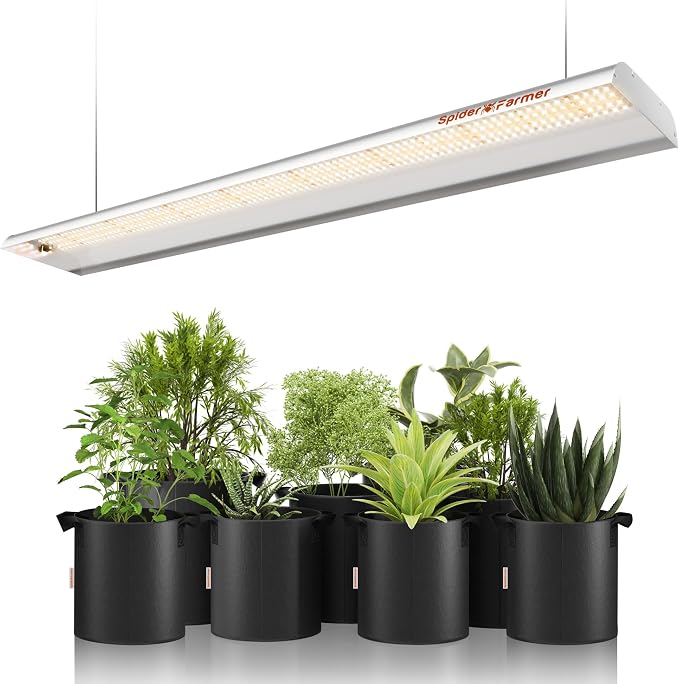
The Spider Farmer SF600 is the longer, integrated fixture to compare for a rectangular growing area. We recommend its form for buyers who would rather hang one long assembly than arrange several separate short bars. That can simplify the physical layout above trays, provided the fixture and hanging hardware fit inside the available space.
Allow room for the power supply, cable exits, and raising or lowering the fixture. Check the current package and its controls instead of assuming it includes a dimmer or timer. External reviews discuss earlier SF600 versions, and the currently observed listing gives different power wording from older documents. For that reason, confirm the current model's input draw before calculating cost, and use its current instructions for mounting. The benefit is the tidy rectangular arrangement; the limitation is that a long fixture is less adaptable to an isolated pot or a narrow furniture corner. A staged product photograph does not establish uniform light across its entire pictured display.
View Spider Farmer SF600 on Amazon (paid link)
Make the setup easy to use
Make the timer fit the room
A routine that runs without daily reminders is one of the best practical improvements you can make. Decide when you want the display illuminated and when you want the room dark, then check that the schedule fits the plant's care guidance. The lamp should help you enjoy the room rather than become something you repeatedly switch off because it interferes with reading, work, or sleep.
Confirm how the exact fixture behaves after the timer removes and restores power. An electronic control that needs another button press can frustrate an otherwise sensible plan. Keep the switch accessible after routing the cord. If reaching it means moving three pots, change the arrangement before you settle into regular use.
Track the arrangement, not just the switch
Record the light position, daily schedule, and date of installation. Take a reference photograph in consistent ordinary lighting, then use later pictures and new growth to evaluate your care routine. A photograph is a record, not a calibrated measurement, and a change in the plant does not prove that the lamp caused it. Keep watering, temperature, and other care observations alongside the lighting notes.
If you measure output, record the reading at foliage height and the lamp setting. Check the outer leaves as well as the center. PPFD describes light arriving at an area; a manufacturer's PPF figure describes overall output and cannot replace those placement details. A reading made with a phone also needs the appropriate settings or calibration for its light source. Preserve that context so a later adjustment is a comparison you can understand.
Estimate the complete running cost
Use actual input watts for every lamp you will operate. As an illustration, a 20W arrangement running twelve hours daily for thirty days uses 7.2 kWh. At an assumed $0.15 per kWh, that is $1.08. Replace both numbers with your planned power draw and local tariff. This estimate excludes purchase cost and other equipment; it is not a quoted bill or a recommended schedule. Our light-and-cost calculator makes that arithmetic easier when you are comparing two complete setups.
Plan for flowers as well as foliage
For one or two compact orchids, keep the station easy to adjust and resist building a crowded cabinet before you know how you will use it. A shelf layout that lets you remove the plants individually is a strong starting point. Short bars are worth comparing when the available growing area is divided into small sections.
For a larger collection with several orchid groups, plan separate zones with their own recorded lighting arrangements. That makes differences in height and schedule easier to manage. A single long fixture may suit a uniform row, but several physically separate areas give you more options when the plants need different treatment.
For plants displayed while flowering, leave a taller destination available. That can be an upper shelf or another suitable location, depending on the room and care requirements. Do not assume that a fixture above one shelf also lights the shelf above it. Owner discussions frequently raise these layout questions; they are useful prompts to inspect your own arrangement, not proof that a particular product will flower your orchids.
Our recommendation
Choose lighting after identifying your orchids and measuring both foliage and spike clearance. We recommend an adjustable shelf arrangement that allows plants to be removed individually and grouped by compatible needs. Compare Barrina bars for smaller modular areas and the SF600 form for a longer uninterrupted row.
Before buying, check the exact package, mounting conditions, usable height adjustment, and current coverage information. If a shelf fits the pots but prevents the plants from flowering without hitting the fixture, revise the shelf plan. The best purchase supports the collection you have and leaves room for its normal changes.
When you are ready to compare listings, consider Barrina T5 1FT white-cover four-pack (paid link) for a modular compact shelf; Spider Farmer SF600 (paid link) for a longer rectangular growing station. Check the selected version and included components before ordering.
Research sources and scope
Plant guidance comes from the references below. Fixture links accompany the relevant recommendations. Arrangement examples and purchasing advice are our analysis. We report no hands-on product trials or independently measured growing footprints.
- Growing orchids under lights — American Orchid Society ↗Reviewed 2026-09-27
- Iowa State Extension: supplemental indoor light and measurement concepts ↗Reviewed 2026-09-27
- Independent Barrina review; longer version, not an exact one-foot test ↗Reviewed 2026-09-27
- Independent SF300/SF600 measurements; earlier versions and stated test conditions ↗Reviewed 2026-09-27
- SF600 setup review; gifted unit and affiliate disclosure, numerical claims excluded ↗Reviewed 2026-09-27