Peace lily grow lights: a practical decision guide
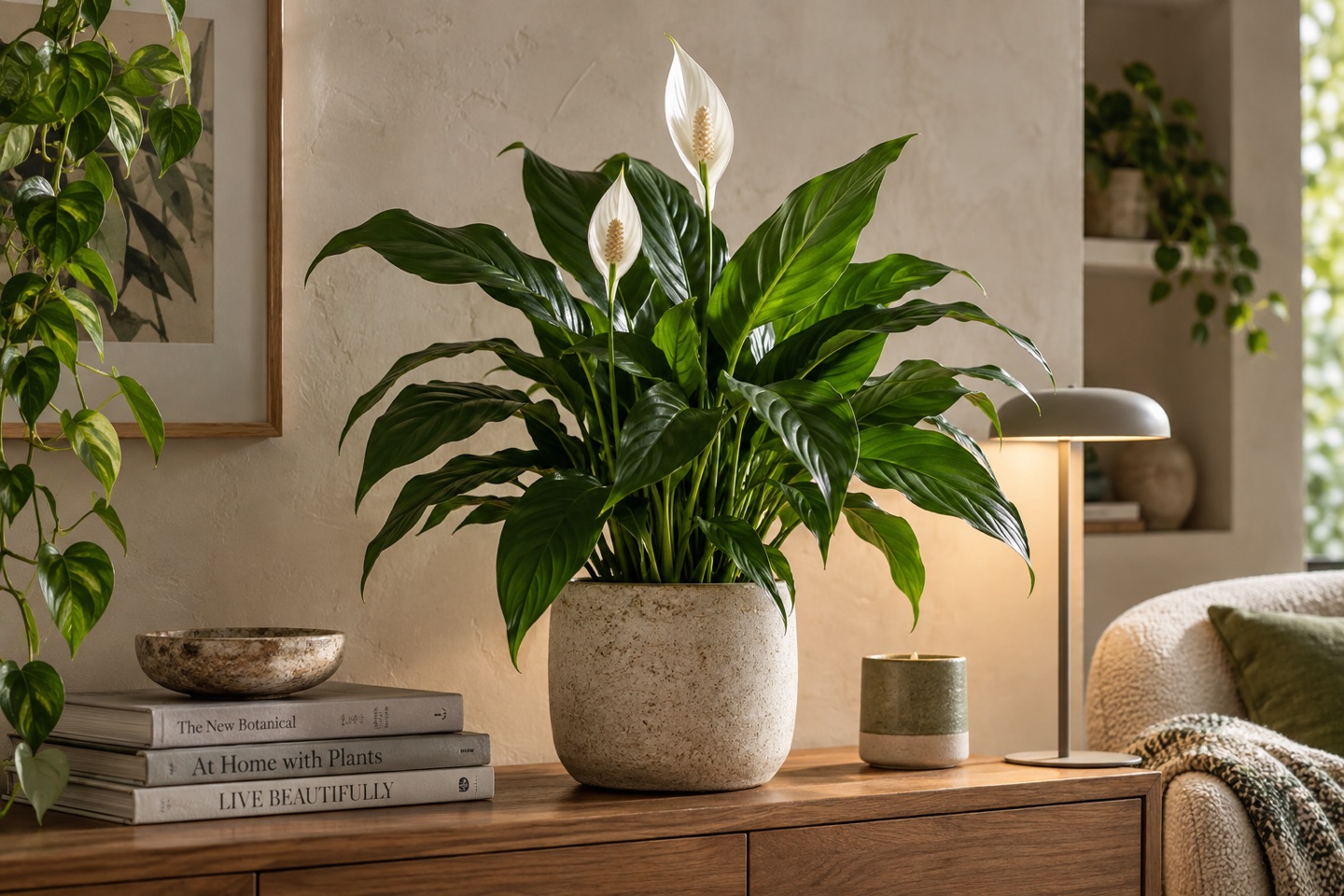
A peace lily can make a welcoming plant display without requiring a room full of growing equipment. When its intended position needs supplemental light, the useful choice is usually a straightforward arrangement around the leaves and the furniture. The question is how to give that plant a workable location while keeping care simple.
We recommend comparing an adjustable clip-on for a compact display with a compatible grow bulb when you already have a suitable lamp. Start with the peace lily's leaf spread and existing daylight, then check the physical combination. This guide helps you decide whether another fixture is useful and which form belongs in your room.
As an Amazon Associate I earn from qualifying purchases. Amazon links below are paid links. Read our disclosure.
This guide combines source-based research with practical arrangement advice. We have not conducted hands-on product tests.
Use the plant reference
Keep the variety and size of your plant in mind. Peace lilies are sold in quite different forms, and a fixture that fits a small desk plant can be awkward above a mature floor display. North Carolina Extension's Spathiphyllum reference provides the plant-care context; it does not identify a universal lamp or a guaranteed flowering program.
Decide what you want to improve. Perhaps you want to place the plant in a corner with less useful daylight, or supplement a position that changes seasonally. If the current location already suits the plant, another lamp may add complexity without solving a defined problem. Choose the care arrangement first so the equipment has a clear purpose.
NC State Extension describes peace lilies as shade-preferring plants and advises against direct sun. Treat that as broad care context, not an exact numerical optimum for every species or cultivar.
Check whether the plant occupies a dim room corner or receives useful indirect window light. Write down what you are trying to improve before introducing a lamp.
Cover the broad leaves
Measure across the outer leaves rather than across the pot. Broad leaves can occupy much more space than the container, and the tallest leaf is not necessarily the one nearest the proposed lamp. Include those positions in a simple side-view sketch.
A clamp can be convenient when a suitable furniture edge lets the arm reach over a compact plant. A separate lamp can be more useful when the plant stands beyond that reach or you want a different visual style. Check the complete fixture's dimensions and clearance before ordering a bulb. Leave access around the pot, including room to remove any cover container. A neat display should not make watering require dismantling the light every time.
Measure the foliage width and the heights of the main leaves. A small beam aimed at the middle of a large pot may not represent the exposure across the whole plant.
A movable lamp can be compared for reach; a standard-base plant bulb needs a suitable fixture beyond a matching socket. Look at the real placement possibilities before comparing advertised power.
Do not diagnose every symptom as light
Use changes in the plant as a reason to inspect its overall care, rather than immediately buying a stronger lamp. The plant reference includes watering and other conditions as well as light. A single symptom does not prove which part of the routine needs attention.
After adding supplemental light, record the position and schedule and keep the rest of your observations beside them. Look at new growth and the complete plant over time rather than expecting damaged leaves to demonstrate a quick recovery. If you make another adjustment, note what changed. This is a practical way to evaluate the arrangement without turning an uncertain diagnosis into a series of increasingly expensive product purchases.
The NC State reference identifies several possible causes of leaf-tip problems. A leaf symptom therefore does not justify a specific lamp or a numerical PPFD target by itself.
Record water and room conditions alongside lamp position. Make measured, documented changes rather than buying a brighter fixture as the first answer to every problem. We do not claim that any candidate lamp guarantees flowers or fixes yellow leaves.
Choose a fixture that suits this job
SANSI 10W adjustable clip-on
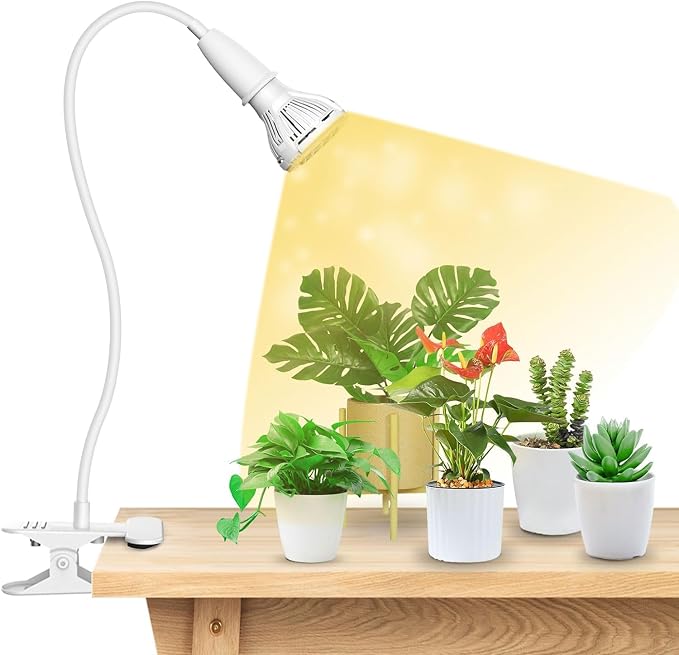
For one compact plant display, we recommend the SANSI one-head 10W clip-on as an adjustable option when the furniture provides a suitable mounting edge. The clamp leaves the surface available for the pot, while the arm lets you position the head independently of that attachment point. That is particularly useful beside a desk or a small plant stand where another lamp base would be inconvenient.
The bulb can be replaced separately, giving you a component to change rather than necessarily replacing the whole fixture. Check compatible replacements and the fixture rating before ordering a different bulb. Plan the arrangement around the plant's foliage and leave the required clearance: SANSI's precautions specify at least one foot and warn against touching the operating bulb. For a wide display, choose a wider lighting arrangement rather than expecting this small head to reach every plant. We have not established its exact growing footprint through independent measurements.
View SANSI 10W adjustable clip-on on Amazon (paid link)
GE BR30 Seeds and Greens
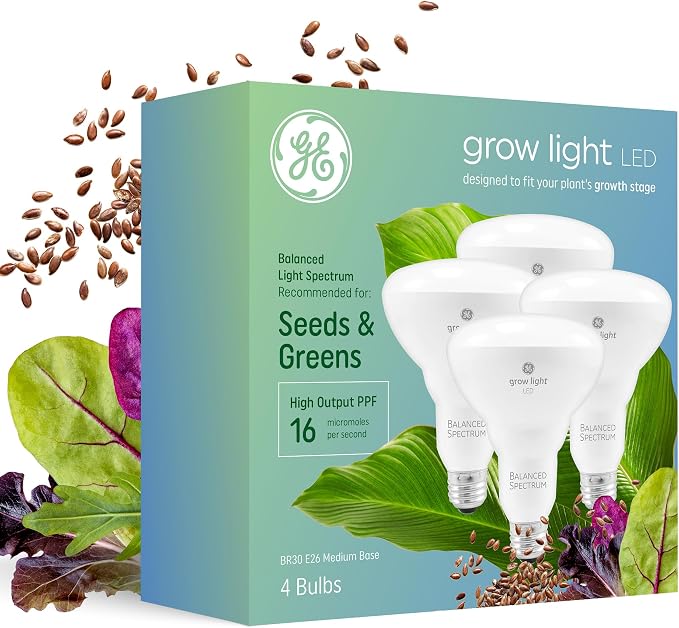
The GE BR30 Seeds and Greens bulb is an alternative to compare when you already have a compatible lamp and want a straightforward bulb change. GE's documentation identifies an E26-type medium base and a non-dimmable design. Our verified Amazon destination is a four-pack; check the package quantity before buying when you only need one bulb.
We recommend this approach to buyers who can use an existing suitable fixture, because reusing that lamp may keep the installation simple. Check its rating, physical space around the bulb, and the GE instructions before installing it. A matching screw base alone does not confirm that every lamp shade or enclosure is appropriate. The published PPF describes total photon output, not the light reaching each leaf at your chosen distance. This is a useful bulb option to evaluate, rather than a promise that one bulb serves an entire shelf. Choose a dedicated shelf fixture when the growing area calls for a longer arrangement.
View GE BR30 Seeds and Greens on Amazon (paid link)
Make the setup easy to use
Make the timer fit the room
A routine that runs without daily reminders is one of the best practical improvements you can make. Decide when you want the display illuminated and when you want the room dark, then check that the schedule fits the plant's care guidance. The lamp should help you enjoy the room rather than become something you repeatedly switch off because it interferes with reading, work, or sleep.
Confirm how the exact fixture behaves after the timer removes and restores power. An electronic control that needs another button press can frustrate an otherwise sensible plan. Keep the switch accessible after routing the cord. If reaching it means moving three pots, change the arrangement before you settle into regular use.
Track the arrangement, not just the switch
Record the light position, daily schedule, and date of installation. Take a reference photograph in consistent ordinary lighting, then use later pictures and new growth to evaluate your care routine. A photograph is a record, not a calibrated measurement, and a change in the plant does not prove that the lamp caused it. Keep watering, temperature, and other care observations alongside the lighting notes.
If you measure output, record the reading at foliage height and the lamp setting. Check the outer leaves as well as the center. PPFD describes light arriving at an area; a manufacturer's PPF figure describes overall output and cannot replace those placement details. A reading made with a phone also needs the appropriate settings or calibration for its light source. Preserve that context so a later adjustment is a comparison you can understand.
Estimate the complete running cost
Use actual input watts for every lamp you will operate. As an illustration, a 20W arrangement running twelve hours daily for thirty days uses 7.2 kWh. At an assumed $0.15 per kWh, that is $1.08. Replace both numbers with your planned power draw and local tariff. This estimate excludes purchase cost and other equipment; it is not a quoted bill or a recommended schedule. Our light-and-cost calculator makes that arithmetic easier when you are comparing two complete setups.
Find the simplest arrangement for your peace lily
For a compact plant on a desk or table, the SANSI clip-on is worth considering when its clamp and arm fit comfortably. It leaves the tabletop available for the pot and lets you position the head independently of its base. Check its required clearance and the view from nearby seating before deciding where to attach it.
For a plant beside an existing suitable lamp, the GE Seeds and Greens bulb is a separate option to compare. The verified Amazon destination is a four-pack, so check whether that quantity makes sense for you. Compatibility involves the fixture's rating, ventilation, and space around the bulb, not only the screw base. Avoid choosing a multipack simply because it looks like better value when you need one different arrangement.
For a large floor-standing peace lily, measure the display before buying either option. If the canopy lies beyond the clamp's useful reach, start with a suitable larger support arrangement. Do not force a small tabletop fixture into that job. A lamp that reaches the intended growing area and remains easy to use will be more useful than one selected because the package mentions houseplants.
Our recommendation
For a compact peace lily, we recommend comparing a convenient adjustable clamp with a compatible bulb in an existing suitable lamp. Choose the route that reaches the full foliage while keeping the room and watering routine comfortable.
For a larger plant, plan the support and leaf spread before selecting a fixture. Keep flowering expectations tied to plant-care evidence, and investigate changes in the whole routine rather than treating every symptom as a lighting diagnosis. A simple, accessible arrangement with a defined job is a sensible purchase; buying more lamps without that plan is unlikely to make the decision clearer.
When you are ready to compare listings, consider SANSI 10W adjustable clip-on (paid link) for an adjustable compact display; GE BR30 Seeds and Greens four-pack (paid link) for a compatible existing lamp, with pack quantity checked. Check the selected version and included components before ordering.
Research sources and scope
Plant guidance comes from the references below. Fixture links accompany the relevant recommendations. Arrangement examples and purchasing advice are our analysis. We report no hands-on product trials or independently measured growing footprints.
- Peace lily — NC State Extension ↗Reviewed 2026-09-27
- Iowa State Extension: supplemental indoor light and measurement concepts ↗Reviewed 2026-09-27
- Independent review: SANSI multi-head clip-on; model differs ↗Reviewed 2026-09-27