Snake plants and grow lights: when supplementation helps
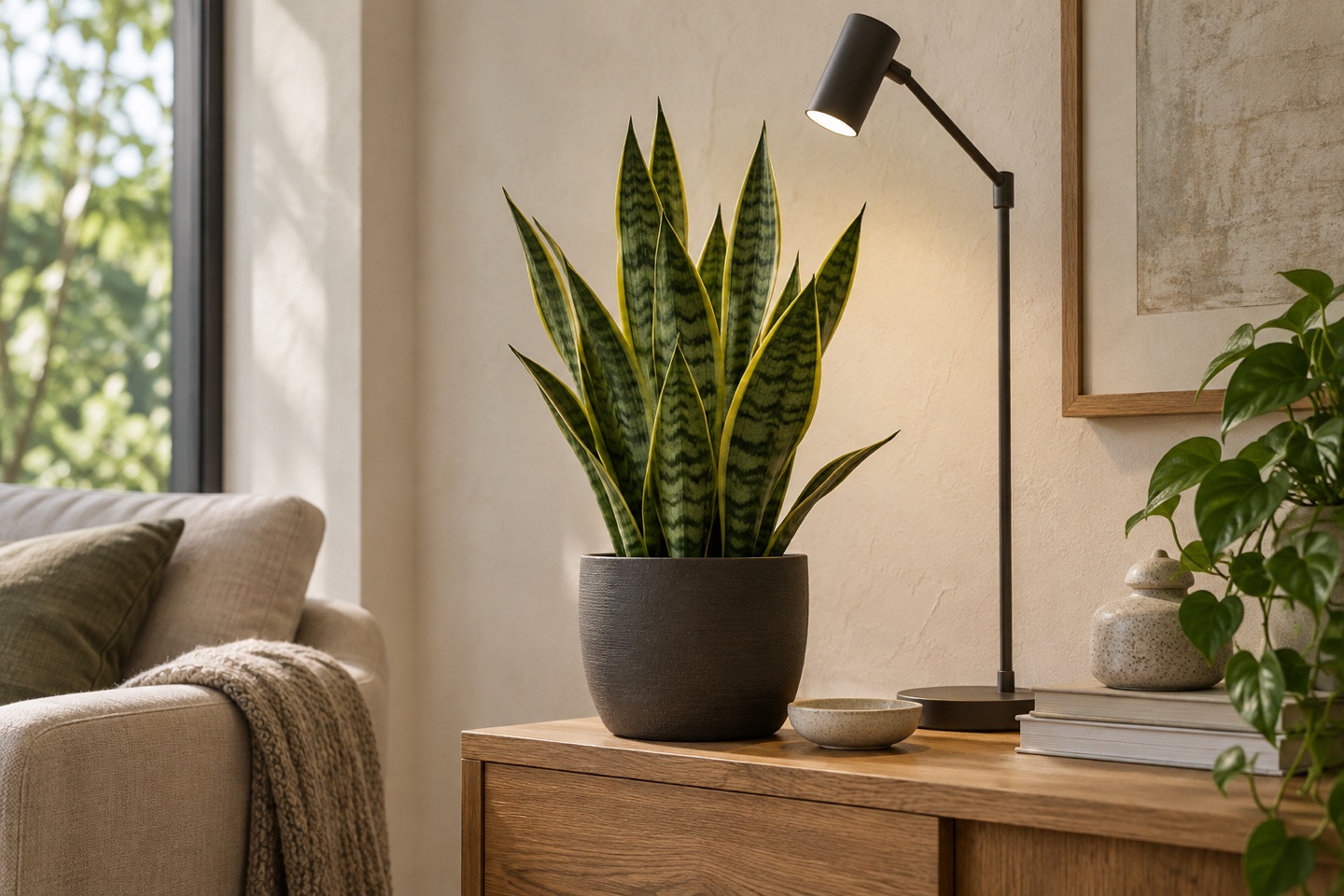
A snake plant is often chosen for a corner where other plants seem inconvenient. That does not mean every dim corner offers the same growing conditions, or that every snake plant needs a lamp. The useful question is whether lighting will help you maintain the particular display you want.
We recommend starting with the location and the plant's shape. A compact cultivar can suit a focused clamp arrangement, while a taller plant may need a different fixture position. If you already own a compatible lamp, a grow bulb is another route to compare. This guide helps you choose deliberately instead of equating low-light tolerance with an unlimited choice of locations.
As an Amazon Associate I earn from qualifying purchases. Amazon links below are paid links. Read our disclosure.
This guide combines source-based research with practical arrangement advice. We have not conducted hands-on product tests.
Look at the location before the shopping list
Observe the plant's position during the day. A room can feel bright to you while the leaves sit in a shaded spot behind furniture or away from the window. Note whether there is a suitable alternative location before buying a lamp. A move may be simpler if it preserves the display you want.
If the plant needs to stay in its current corner, decide what lighting equipment you are willing to leave there. A small side table may provide a clamp edge; a floor location may offer no sensible place for one. Treat the room arrangement as part of the purchase. The easiest light to buy is not necessarily the easiest light to position beside your plant.
NC State Extension notes that Dracaena trifasciata tolerates very low light. A plant in an adequately lit room is a different case from one far from a window. Decide whether you are trying to maintain the current plant or improve an especially dim placement.
Photograph the arrangement and note useful window light. A lamp is not a substitute for identifying overwatering or root problems; this guide only addresses the lighting decision.
Cover the leaf arrangement
Include the whole height of the foliage in your sketch. A tall snake plant can place its tips much closer to an overhead head than the lower leaves. A compact rosette occupies a shallower, wider shape. Do not use the same mounting plan for both simply because they share a common name.
For a floor plant, check whether you can position the light without creating an obstacle beside the pot. For a small plant on furniture, leave room to lift it out for care. Keep the fixture clear of the leaves and follow its minimum clearance instructions. If a short arm can only aim at the tallest tips, compare another arrangement instead of assuming that a brighter bulb fixes the physical fit.
Tall leaves may reach well above the pot while a compact cultivar stays low. Measure the tallest leaf and the width of the cluster before choosing a clamp arm or fixture height. Keep the fixture’s physical reach separate from its output claim.
A standard-base plant bulb can be considered only in a fixture compatible with its electrical, physical and ventilation requirements. A matching screw base is one check, not the complete compatibility test.
Avoid paying for unused coverage
Choose the controls around the routine you will use. A timer can make supplemental lighting easier to maintain, but the light must restart correctly after power returns. Check that behavior before relying on an external timer. Leave switches accessible, especially when the plant stands in a corner behind furniture.
Keep the lighting change separate from changes in watering. The plant reference emphasizes careful watering and drainage; a lamp purchase does not replace those requirements. Record what you changed so later observations have useful context. For a low-maintenance display, favor an arrangement that is easy to inspect and clean rather than a complex installation hidden behind the plant.
Do not buy a large shelf panel simply because its wattage is greater. Compare the useful light footprint with one plant’s placement and check whether the lamp can be installed neatly. Review the purchase if the only available mounting position is impractical.
We do not assign a precise optimum PPFD for every snake-plant cultivar. Use the source’s plant context, the exact lamp documentation and measurements at the intended position.
Choose a fixture that suits this job
SANSI 10W adjustable clip-on
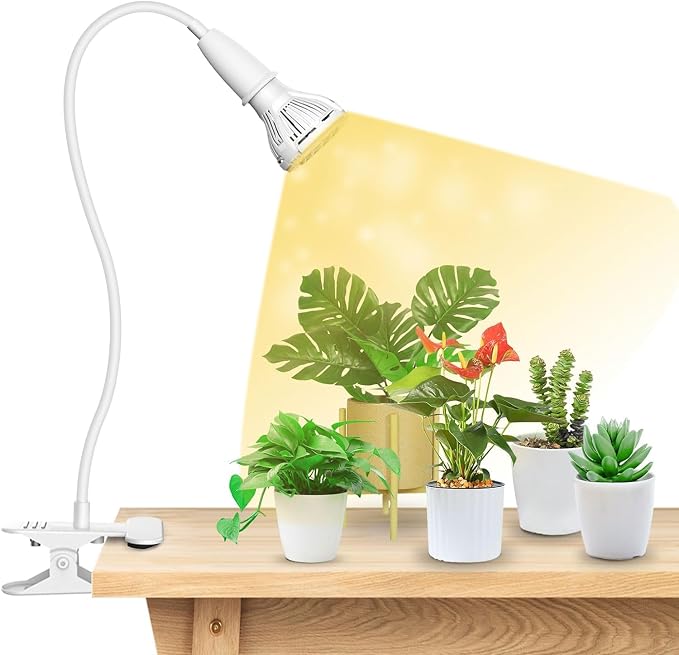
For one compact plant display, we recommend the SANSI one-head 10W clip-on as an adjustable option when the furniture provides a suitable mounting edge. The clamp leaves the surface available for the pot, while the arm lets you position the head independently of that attachment point. That is particularly useful beside a desk or a small plant stand where another lamp base would be inconvenient.
The bulb can be replaced separately, giving you a component to change rather than necessarily replacing the whole fixture. Check compatible replacements and the fixture rating before ordering a different bulb. Plan the arrangement around the plant's foliage and leave the required clearance: SANSI's precautions specify at least one foot and warn against touching the operating bulb. For a wide display, choose a wider lighting arrangement rather than expecting this small head to reach every plant. We have not established its exact growing footprint through independent measurements.
View SANSI 10W adjustable clip-on on Amazon (paid link)
GE BR30 Seeds and Greens
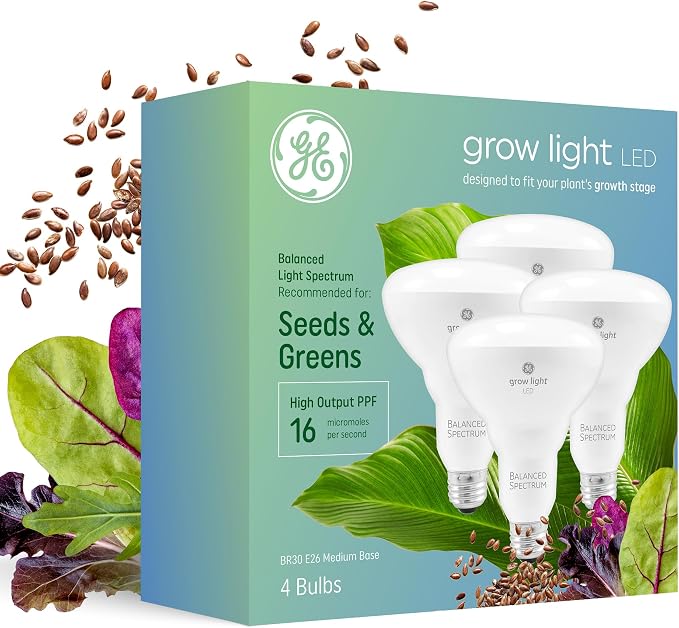
The GE BR30 Seeds and Greens bulb is an alternative to compare when you already have a compatible lamp and want a straightforward bulb change. GE's documentation identifies an E26-type medium base and a non-dimmable design. Our verified Amazon destination is a four-pack; check the package quantity before buying when you only need one bulb.
We recommend this approach to buyers who can use an existing suitable fixture, because reusing that lamp may keep the installation simple. Check its rating, physical space around the bulb, and the GE instructions before installing it. A matching screw base alone does not confirm that every lamp shade or enclosure is appropriate. The published PPF describes total photon output, not the light reaching each leaf at your chosen distance. This is a useful bulb option to evaluate, rather than a promise that one bulb serves an entire shelf. Choose a dedicated shelf fixture when the growing area calls for a longer arrangement.
View GE BR30 Seeds and Greens on Amazon (paid link)
Make the setup easy to use
Make the timer fit the room
A routine that runs without daily reminders is one of the best practical improvements you can make. Decide when you want the display illuminated and when you want the room dark, then check that the schedule fits the plant's care guidance. The lamp should help you enjoy the room rather than become something you repeatedly switch off because it interferes with reading, work, or sleep.
Confirm how the exact fixture behaves after the timer removes and restores power. An electronic control that needs another button press can frustrate an otherwise sensible plan. Keep the switch accessible after routing the cord. If reaching it means moving three pots, change the arrangement before you settle into regular use.
Track the arrangement, not just the switch
Record the light position, daily schedule, and date of installation. Take a reference photograph in consistent ordinary lighting, then use later pictures and new growth to evaluate your care routine. A photograph is a record, not a calibrated measurement, and a change in the plant does not prove that the lamp caused it. Keep watering, temperature, and other care observations alongside the lighting notes.
If you measure output, record the reading at foliage height and the lamp setting. Check the outer leaves as well as the center. PPFD describes light arriving at an area; a manufacturer's PPF figure describes overall output and cannot replace those placement details. A reading made with a phone also needs the appropriate settings or calibration for its light source. Preserve that context so a later adjustment is a comparison you can understand.
Estimate the complete running cost
Use actual input watts for every lamp you will operate. As an illustration, a 20W arrangement running twelve hours daily for thirty days uses 7.2 kWh. At an assumed $0.15 per kWh, that is $1.08. Replace both numbers with your planned power draw and local tariff. This estimate excludes purchase cost and other equipment; it is not a quoted bill or a recommended schedule. Our light-and-cost calculator makes that arithmetic easier when you are comparing two complete setups.
Find the simplest arrangement that fits
For a small snake plant on a desk, the clip-on route can keep the surface free of another base. It works best when the edge, arm reach, and required lamp clearance all suit the foliage. Check the view from your seated position before deciding that the lamp belongs there.
For a compact plant beside an existing lamp, the GE bulb is a route to compare after checking the fixture's rating and ventilation. A four-pack is useful only if its quantity suits your plans; buying spare bulbs does not improve an unsuitable mounting position. Check the actual package and any available alternatives.
For a tall plant on the floor, prioritize a fixture arrangement that can serve the plant's shape. That may mean a suitable separately positioned lamp rather than the small clamp design. Make a sketch showing the upper leaves, lower foliage, and normal walking route. If you cannot find a comfortable location for the light, moving the plant or changing the fixture style is a better first decision than buying more power.
Our recommendation
Buy supplemental lighting when it helps you provide a suitable location you want to keep. We recommend a compact clip arrangement for a small accessible display, or a compatible bulb arrangement where an existing lamp gives you better positioning options.
Before buying, check the plant's height and width, the available mounting point, the room's daylight, and your normal sightline. Keep drainage and watering in the care plan. If the current location already suits the plant, another lamp may add expense and clutter without a clear purpose.
When you are ready to compare listings, consider SANSI 10W adjustable clip-on (paid link) for an adjustable compact display; GE BR30 Seeds and Greens four-pack (paid link) for a compatible existing lamp, with pack quantity checked. Check the selected version and included components before ordering.
Research sources and scope
Plant guidance comes from the references below. Fixture links accompany the relevant recommendations. Arrangement examples and purchasing advice are our analysis. We report no hands-on product trials or independently measured growing footprints.
- Snake plant — NC State Extension ↗Reviewed 2026-09-27
- Iowa State Extension: supplemental indoor light and measurement concepts ↗Reviewed 2026-09-27
- Independent review: SANSI multi-head clip-on; model differs ↗Reviewed 2026-09-27