Does a spider plant need a grow light?
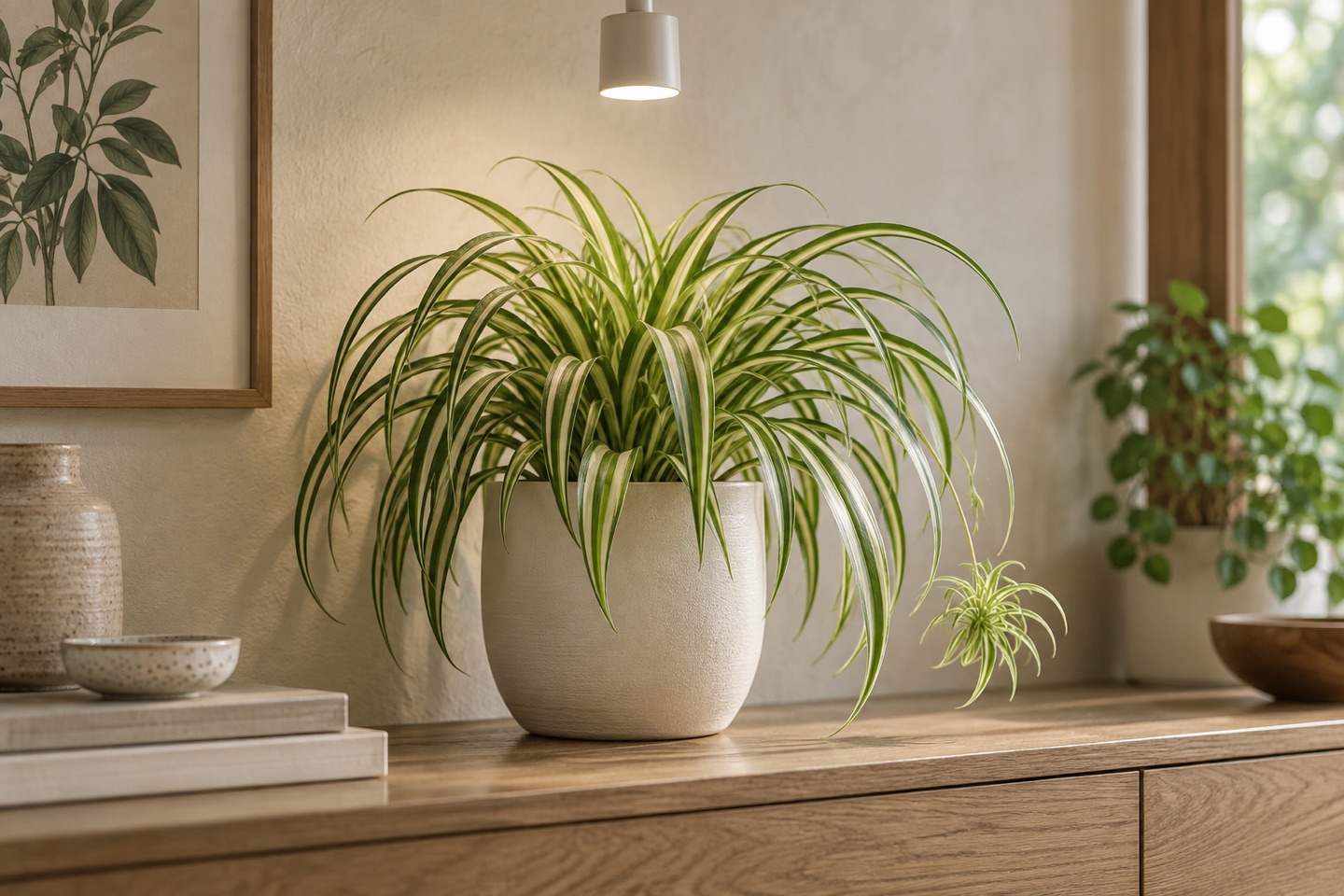
A spider plant does not automatically need another piece of equipment. If it already has a suitable position and is growing well, adding a lamp may solve no real problem. A grow light becomes more interesting when you want to keep the plant in a darker spot or organize a display away from the most useful window.
We recommend deciding on the role of the light before buying: a compact adjustable lamp for one defined location, or a suitable grow bulb in a lamp you can already position. This guide helps you plan around the spider plant's spreading leaves and hanging growth, while avoiding a purchase based only on its reputation for tolerating low light.
As an Amazon Associate I earn from qualifying purchases. Amazon links below are paid links. Read our disclosure.
This guide combines source-based research with practical arrangement advice. We have not conducted hands-on product tests.
Make the purchase conditional
Look at the current location over several days rather than deciding from a bright afternoon. Note when the plant receives daylight and whether furniture or curtains shade it for much of the day. If another suitable position is available, moving the plant may be the simplest first step before buying equipment.
When the location matters to your room, a supplemental lamp can give you another arrangement to explore. A desk plant and a hanging basket create different positioning tasks. Keep your goal specific: you might want a dedicated light beside a bookshelf, or a way to leave a basket in a corner that lacks useful daylight. That is more helpful than assuming the plant needs the strongest lamp you can find.
NC State Extension describes spider plants as preferring medium light while tolerating shade. That makes a grow light a situational purchase rather than compulsory equipment for every plant. Check whether the plant is in a dim corner or already receives suitable indirect window light.
Brown tips alone are not proof that the lamp is too weak. Record watering and other care conditions before making lighting the explanation for every symptom.
Remember the hanging shape
A spider plant's leaves can spread well beyond its container. Draw the outline of that spread and include any trailing stems you want to keep clear of the hardware. Check the arrangement from the front, not just from above, because a lamp and a hanging basket can interfere with the same working space.
For a plant on a table, leave a route for lifting the pot. For a basket, plan how you remove it for care without catching stems on a cord or arm. Keep the lamp anchored to an appropriate support rather than relying on the plant container itself unless the product is specifically designed for that use. A few minutes spent planning access can make the display much easier to live with.
The top rosette and dangling plantlets occupy different positions. Measure the width of the arching leaves and draw where the lamp can reach. A small light aimed only at the centre may leave much of a large hanging plant outside its useful footprint.
Check the support used for the lamp separately from the basket support. Do not assume a basket hook is rated for extra equipment or that a clamp can grip its curved edge.
Do not use an automatic long-day setting
Choose the fixture form based on the display. A clamp lamp works when there is a stable, accessible furniture edge and the arm can reach above the foliage. A bulb in a compatible fixture works when you have a better mounting option elsewhere. Decide which arrangement preserves the room's useful surfaces and normal sightlines.
Do not use plantlets or a single leaf tip as the sole test of whether the lamp is right. Plant appearance and growth can reflect several care conditions, and the spider plant reference describes particular light-and-dark requirements for plantlet formation. Keep that context if producing plantlets is your goal. For a foliage display, focus first on an appropriate, maintainable routine instead of adjusting the light repeatedly to chase one visible result.
NC State identifies a short-day, uninterrupted-night response for plantlet development. If plantlets are your goal, use that source rather than applying a generic seedling schedule. Keep the timer setting tied to the objective and the actual plant.
Our calculator reports the light quantity from entered PPFD and hours. It cannot judge a spider plant’s photoperiodic response or promise plantlets.
Choose a fixture that suits this job
SANSI 10W adjustable clip-on
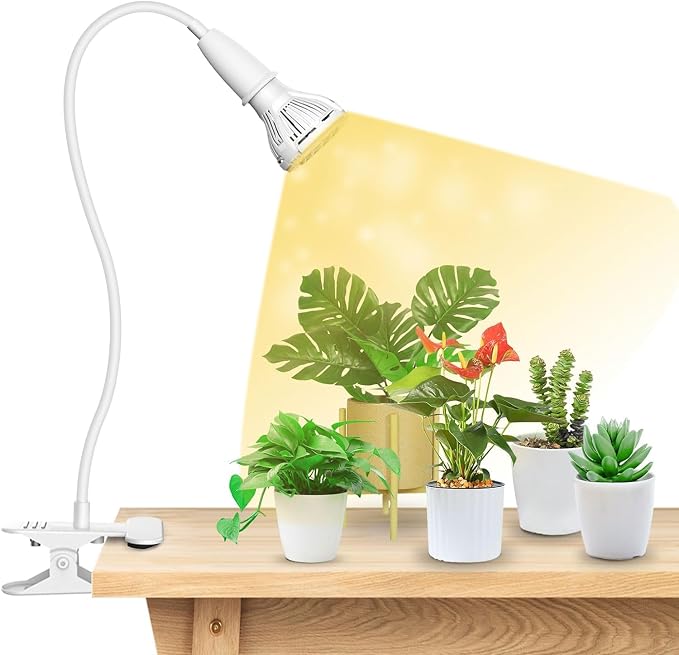
For one compact plant display, we recommend the SANSI one-head 10W clip-on as an adjustable option when the furniture provides a suitable mounting edge. The clamp leaves the surface available for the pot, while the arm lets you position the head independently of that attachment point. That is particularly useful beside a desk or a small plant stand where another lamp base would be inconvenient.
The bulb can be replaced separately, giving you a component to change rather than necessarily replacing the whole fixture. Check compatible replacements and the fixture rating before ordering a different bulb. Plan the arrangement around the plant's foliage and leave the required clearance: SANSI's precautions specify at least one foot and warn against touching the operating bulb. For a wide display, choose a wider lighting arrangement rather than expecting this small head to reach every plant. We have not established its exact growing footprint through independent measurements.
View SANSI 10W adjustable clip-on on Amazon (paid link)
GE BR30 Seeds and Greens
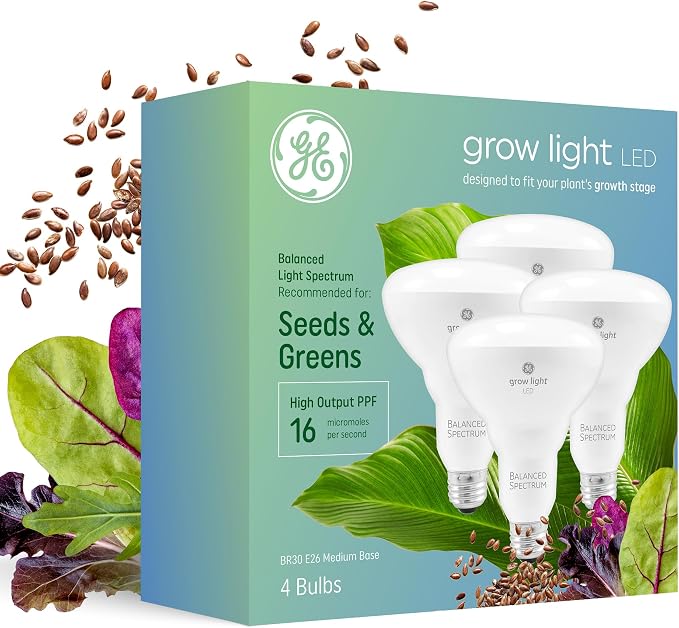
The GE BR30 Seeds and Greens bulb is an alternative to compare when you already have a compatible lamp and want a straightforward bulb change. GE's documentation identifies an E26-type medium base and a non-dimmable design. Our verified Amazon destination is a four-pack; check the package quantity before buying when you only need one bulb.
We recommend this approach to buyers who can use an existing suitable fixture, because reusing that lamp may keep the installation simple. Check its rating, physical space around the bulb, and the GE instructions before installing it. A matching screw base alone does not confirm that every lamp shade or enclosure is appropriate. The published PPF describes total photon output, not the light reaching each leaf at your chosen distance. This is a useful bulb option to evaluate, rather than a promise that one bulb serves an entire shelf. Choose a dedicated shelf fixture when the growing area calls for a longer arrangement.
View GE BR30 Seeds and Greens on Amazon (paid link)
Make the setup easy to use
Make the timer fit the room
A routine that runs without daily reminders is one of the best practical improvements you can make. Decide when you want the display illuminated and when you want the room dark, then check that the schedule fits the plant's care guidance. The lamp should help you enjoy the room rather than become something you repeatedly switch off because it interferes with reading, work, or sleep.
Confirm how the exact fixture behaves after the timer removes and restores power. An electronic control that needs another button press can frustrate an otherwise sensible plan. Keep the switch accessible after routing the cord. If reaching it means moving three pots, change the arrangement before you settle into regular use.
Track the arrangement, not just the switch
Record the light position, daily schedule, and date of installation. Take a reference photograph in consistent ordinary lighting, then use later pictures and new growth to evaluate your care routine. A photograph is a record, not a calibrated measurement, and a change in the plant does not prove that the lamp caused it. Keep watering, temperature, and other care observations alongside the lighting notes.
If you measure output, record the reading at foliage height and the lamp setting. Check the outer leaves as well as the center. PPFD describes light arriving at an area; a manufacturer's PPF figure describes overall output and cannot replace those placement details. A reading made with a phone also needs the appropriate settings or calibration for its light source. Preserve that context so a later adjustment is a comparison you can understand.
Estimate the complete running cost
Use actual input watts for every lamp you will operate. As an illustration, a 20W arrangement running twelve hours daily for thirty days uses 7.2 kWh. At an assumed $0.15 per kWh, that is $1.08. Replace both numbers with your planned power draw and local tariff. This estimate excludes purchase cost and other equipment; it is not a quoted bill or a recommended schedule. Our light-and-cost calculator makes that arithmetic easier when you are comparing two complete setups.
Choose between three everyday arrangements
For a spider plant on a work desk, the SANSI clip-on is the adjustable option to compare. Its clamp can leave the surface free, provided the head reaches a useful position and the manufacturer clearance is available. Check the seated sightline so the lamp does not become uncomfortable during work.
For a plant beside an existing lamp, compare the GE bulb route only after checking the whole fixture. The four-pack may be convenient if you have several compatible installations, but it is unnecessary stock when you only need one bulb. Compare the available package sizes rather than treating a low per-bulb price as the whole purchase cost.
For a hanging basket with no suitable mounting point nearby, rethink the support arrangement first. Neither a short arm nor a bulb solves missing installation space by itself. Sketch the basket's removal route and keep the light outside it. Buying hardware to fit that plan is more useful than ordering a lamp and improvising its position afterward.
Our recommendation
Add a grow light when it helps create a suitable location you want to keep, rather than because every spider plant display needs one. We recommend a clamp arrangement for a defined furniture spot and a compatible bulb arrangement when an existing lamp gives you a better position.
Before buying, check the foliage spread, the removal route, the mounting point, and the intended light-and-dark routine. Choose the setup that is easy to maintain and comfortable in the room. If the plant already has a suitable location, put the money toward another genuine need instead of adding equipment without a clear task.
When you are ready to compare listings, consider SANSI 10W adjustable clip-on (paid link) for an adjustable compact display; GE BR30 Seeds and Greens four-pack (paid link) for a compatible existing lamp, with pack quantity checked. Check the selected version and included components before ordering.
Research sources and scope
Plant guidance comes from the references below. Fixture links accompany the relevant recommendations. Arrangement examples and purchasing advice are our analysis. We report no hands-on product trials or independently measured growing footprints.
- Spider plant — NC State Extension ↗Reviewed 2026-09-27
- Iowa State Extension: supplemental indoor light and measurement concepts ↗Reviewed 2026-09-27
- Independent review: SANSI multi-head clip-on; model differs ↗Reviewed 2026-09-27