Choosing grow lights for succulents
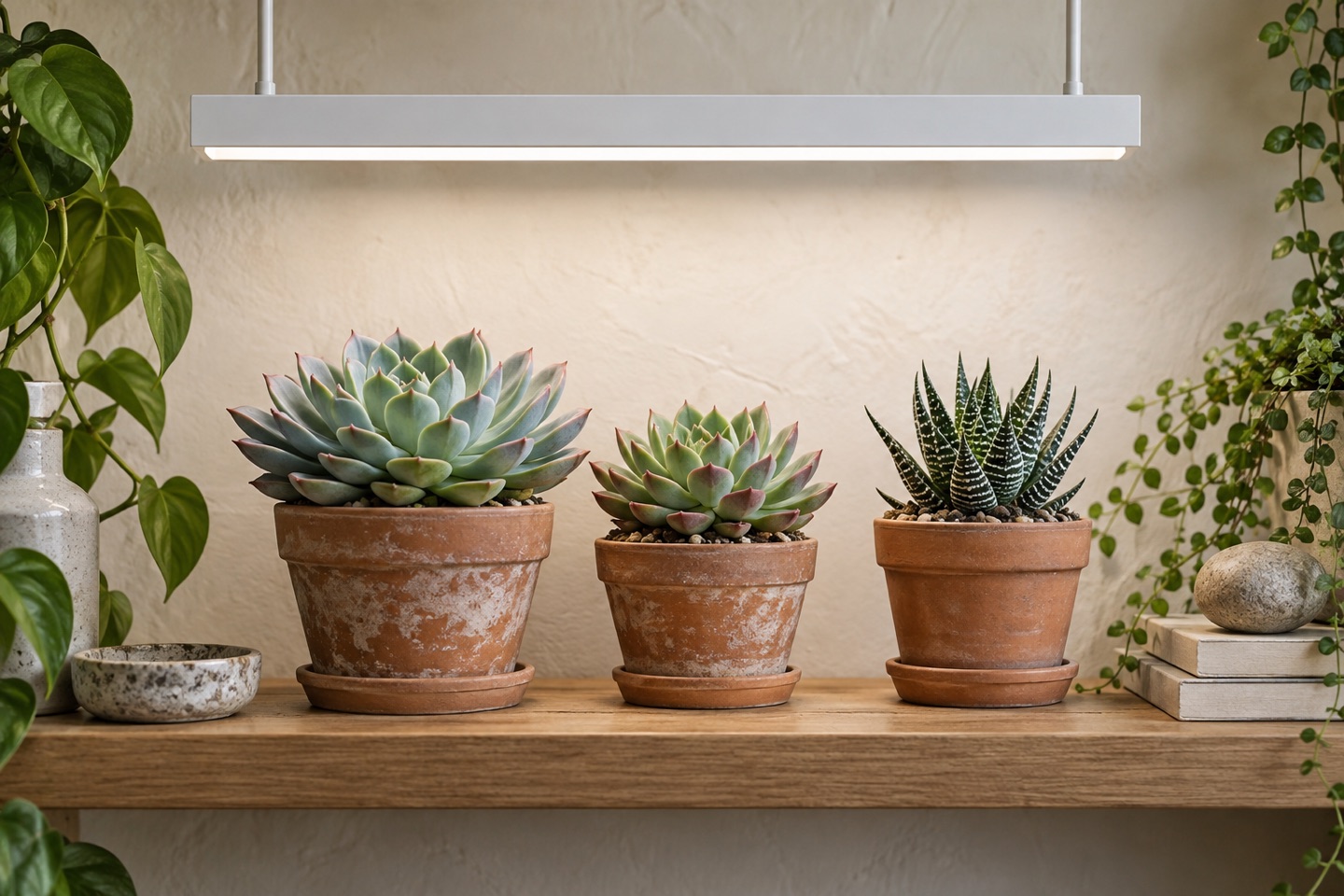
A succulent collection is easy to enjoy and easy to outgrow. A few little pots on a windowsill can become a shelf of rosettes, upright plants, and trailing stems, each occupying a different position. A grow light becomes useful when it gives that collection a workable home rather than simply adding a bright point over the middle.
We recommend identifying the plants, mapping the display, and choosing a fixture form that suits its width and heights. A compatible bulb can serve a focused arrangement; bars or a longer fixture deserve comparison for a dedicated shelf. Here is how to make the purchase without treating every succulent as the same lighting task.
As an Amazon Associate I earn from qualifying purchases. Amazon links below are paid links. Read our disclosure.
This guide combines source-based research with practical arrangement advice. We have not conducted hands-on product tests.
Do not turn a group name into a target
Keep plant names with the collection. Iowa State's indoor succulent guidance discusses supplemental lighting and the effects of inadequate light, but the category includes many plant forms. A broad care overview is useful context; it does not establish one measured target for every species and growing arrangement.
Decide whether the light is supplementing useful daylight or serving a dedicated station farther from the window. Record that difference before comparing products. If the collection includes plants with different care needs, group them in ways that make those needs easier to manage. Choosing a lamp around a deliberate grouping is more useful than buying equipment first and then trying to fit every existing plant underneath it.
Iowa State Extension’s indoor succulent guide is useful general context. It does not make every cactus, Echeveria and Lithops interchangeable. Keep species guidance with each plant rather than copying one precise PPFD target across the tray.
When the collection includes different plants, say which ones a source actually addresses. Missing species-specific numerical evidence should remain missing.
Measure rosettes and taller plants
Measure the outer edges of the rosettes, not only their containers. Add room for offsets and the positions of taller plants. A shelf full of similar pots can contain very different leaf heights, which matters when you plan an overhead fixture.
Place the tallest plants on paper before fixing the light. If they would crowd the head or shade neighboring plants in your arrangement, reorganize the display. For trailing succulents, leave the shelf edge and removal route clear. The goal is an accessible collection whose useful growing area you can describe. A wide photograph beneath a bulb does not establish that its documented distribution matches your exact shelf.
A shelf of low rosettes has a different geometry from the same shelf containing tall upright plants. Arrange the foliage and compare heights before choosing a single mounting distance.
A fixture’s centre reading does not show what arrives at every rosette. Look at its edge values and tested footprint at the height you can achieve. Separate a geometric fit from an evidence-based light decision.
Compare options transparently
Compare lamps at the same footprint and useful height. Keep exact model, revision, and settings with any output map. A large center reading does not describe every rosette at the edges of a shelf, and a wattage label does not replace those details.
Read independent reviews with the same care. A measurement from an earlier fixture or another length of bar can raise useful questions without proving the current version's output. Consider the complete purchase: a bulb needs a compatible lamp, bars need suitable mounts, and a longer assembly needs hanging space. The value comes from the complete arrangement that meets the collection's needs, rather than the lowest headline price for an incomplete setup.
A bulb, bar or panel may each suit a different physical arrangement. Compare current model documents, mounting requirements and actual input power. Do not label a lamp best for growth without comparative trials.
If you change lighting, record the arrangement and other care conditions. Colour or compactness alone cannot establish an exact PPFD value. Use measurements at the foliage when possible and maintain species-specific context.
Choose a fixture that suits this job
SANSI BR30 36W grow bulb
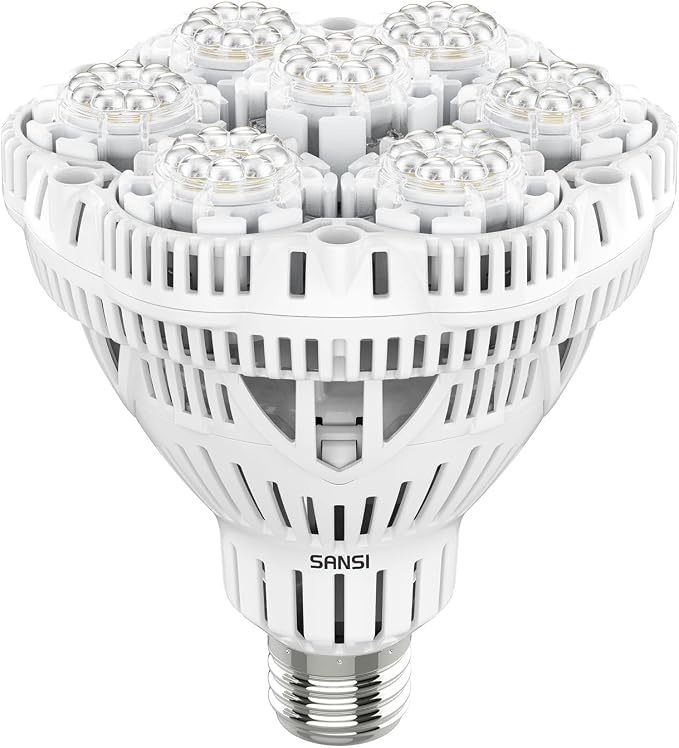
The SANSI BR30 36W bulb is our screw-in option to compare when you want to choose your own suitable fixture. Its appeal is flexibility: a separately purchased lamp can give you the reach, base position, and visual style that work in your room. The US version uses an E26 base, but matching that base is only the first compatibility check.
Compare bulb dimensions, fixture rating, approved orientation, ventilation, and the manufacturer's instructions before combining them. Do not place this 36W bulb in SANSI's 10W clip-on assembly. An open, compatible fixture may suit your plans better than trying to hide a large bulb inside an unsuitable shade. We recommend this route to buyers willing to check the complete combination; a ready-made plant lamp is simpler when you want fewer compatibility decisions. Use the exact BR30 documentation when evaluating output, because an older review of a similarly named SANSI bulb may describe another design.
View SANSI BR30 36W grow bulb on Amazon (paid link)
Barrina T5 shelf-bar family
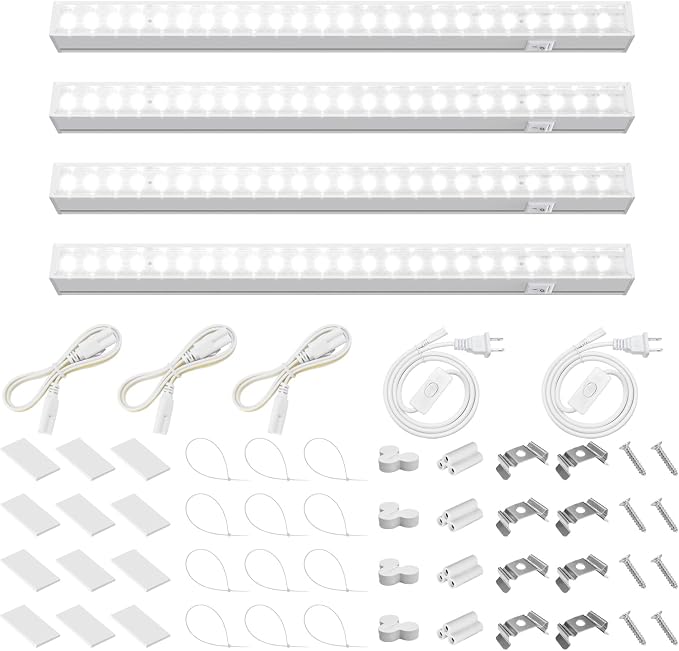
For a compact shelf, the Barrina T5 one-foot, white-cover four-pack is our modular option to compare. Separate bars let you plan their positions around a row of pots or a small tray, rather than placing one spotlight over the middle. The selected listing includes connecting cords and several mounting components, and describes a 20W total across the four bars. Use the exact pack when checking what you need.
This version is non-magnetic; other Barrina listings have different covers and attachment systems. Choose mounting hardware suited to your shelf and follow the surface restrictions in the instructions. For instance, tape has a different job on a smooth panel than on a wire rack. We favor these bars when flexibility in arranging a small shelf matters. The tradeoff is more individual pieces and cables to organize. Do not assume that four bars automatically cover a particular tray: check the intended mounting distance, distribution, and plant requirements before deciding how many to install.
View Barrina T5 shelf-bar family on Amazon (paid link)
Spider Farmer SF600
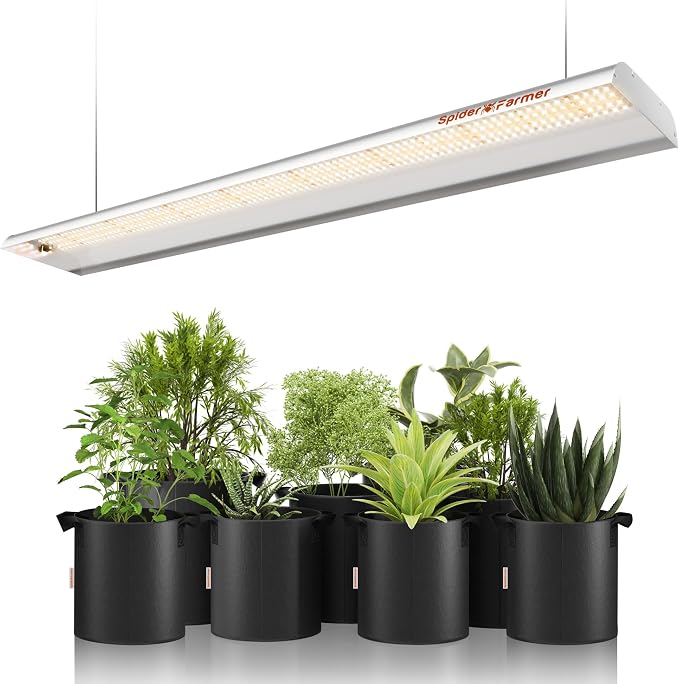
The Spider Farmer SF600 is the longer, integrated fixture to compare for a rectangular growing area. We recommend its form for buyers who would rather hang one long assembly than arrange several separate short bars. That can simplify the physical layout above trays, provided the fixture and hanging hardware fit inside the available space.
Allow room for the power supply, cable exits, and raising or lowering the fixture. Check the current package and its controls instead of assuming it includes a dimmer or timer. External reviews discuss earlier SF600 versions, and the currently observed listing gives different power wording from older documents. For that reason, confirm the current model's input draw before calculating cost, and use its current instructions for mounting. The benefit is the tidy rectangular arrangement; the limitation is that a long fixture is less adaptable to an isolated pot or a narrow furniture corner. A staged product photograph does not establish uniform light across its entire pictured display.
View Spider Farmer SF600 on Amazon (paid link)
Make the setup easy to use
Make the timer fit the room
A routine that runs without daily reminders is one of the best practical improvements you can make. Decide when you want the display illuminated and when you want the room dark, then check that the schedule fits the plant's care guidance. The lamp should help you enjoy the room rather than become something you repeatedly switch off because it interferes with reading, work, or sleep.
Confirm how the exact fixture behaves after the timer removes and restores power. An electronic control that needs another button press can frustrate an otherwise sensible plan. Keep the switch accessible after routing the cord. If reaching it means moving three pots, change the arrangement before you settle into regular use.
Track the arrangement, not just the switch
Record the light position, daily schedule, and date of installation. Take a reference photograph in consistent ordinary lighting, then use later pictures and new growth to evaluate your care routine. A photograph is a record, not a calibrated measurement, and a change in the plant does not prove that the lamp caused it. Keep watering, temperature, and other care observations alongside the lighting notes.
If you measure output, record the reading at foliage height and the lamp setting. Check the outer leaves as well as the center. PPFD describes light arriving at an area; a manufacturer's PPF figure describes overall output and cannot replace those placement details. A reading made with a phone also needs the appropriate settings or calibration for its light source. Preserve that context so a later adjustment is a comparison you can understand.
Estimate the complete running cost
Use actual input watts for every lamp you will operate. As an illustration, a 20W arrangement running twelve hours daily for thirty days uses 7.2 kWh. At an assumed $0.15 per kWh, that is $1.08. Replace both numbers with your planned power draw and local tariff. This estimate excludes purchase cost and other equipment; it is not a quoted bill or a recommended schedule. Our light-and-cost calculator makes that arithmetic easier when you are comparing two complete setups.
Choose for a windowsill, shelf, or growing station
For a small grouping near useful daylight, a suitable lamp with the SANSI BR30 bulb is a focused arrangement to compare. Check compatibility and documented distribution before deciding how many pots belong beneath it. This route can be appealing when you want to choose the lamp's height and style independently.
For several compact plants on a shelf, Barrina bars offer modular placement. Check the selected pack's length and mounting system, then plan the connectors and removal routes. Several separate bars give you layout choices, but the required quantity depends on your growing area and available output information. The number included in the box is not a coverage calculation.
For a dedicated rectangular station, compare a longer SF600 fixture with multiple bars using the same footprint. It may simplify the hanging arrangement, while bars can be easier to distribute around smaller groups. Keep room for taller plants and future changes. Start with the collection you actually have and a little sensible access space; avoid buying a larger installation solely because you might someday fill another rack.
Our recommendation
Choose succulent lighting around identified plants and the actual shape of the collection. We recommend a compatible bulb for a focused display, modular bars for a compact shelf, and a longer assembly when its documented distribution suits a dedicated rectangle.
Measure rosettes and taller foliage separately, preserve clearance, and use plant-specific guidance to interpret the arrangement. Include the lamp or mounts in the price comparison. A comfortable, repeatable installation is the useful investment; a generic promise to suit all succulents does not establish the right choice for your collection.
When you are ready to compare listings, consider SANSI BR30 36W grow bulb (paid link) for a compatible lamp you choose separately; Barrina T5 1FT white-cover four-pack (paid link) for a modular compact shelf; Spider Farmer SF600 (paid link) for a longer rectangular growing station. Check the selected version and included components before ordering.
Research sources and scope
Plant guidance comes from the references below. Fixture links accompany the relevant recommendations. Arrangement examples and purchasing advice are our analysis. We report no hands-on product trials or independently measured growing footprints.
- Growing succulents indoors — Iowa State Extension ↗Reviewed 2026-09-27
- Iowa State Extension: supplemental indoor light and measurement concepts ↗Reviewed 2026-09-27
- Independent SANSI brand review; exact BR30 performance not established ↗Reviewed 2026-09-27
- Independent Barrina review; longer version, not an exact one-foot test ↗Reviewed 2026-09-27
- Independent SF300/SF600 measurements; earlier versions and stated test conditions ↗Reviewed 2026-09-27
- SF600 setup review; gifted unit and affiliate disclosure, numerical claims excluded ↗Reviewed 2026-09-27